
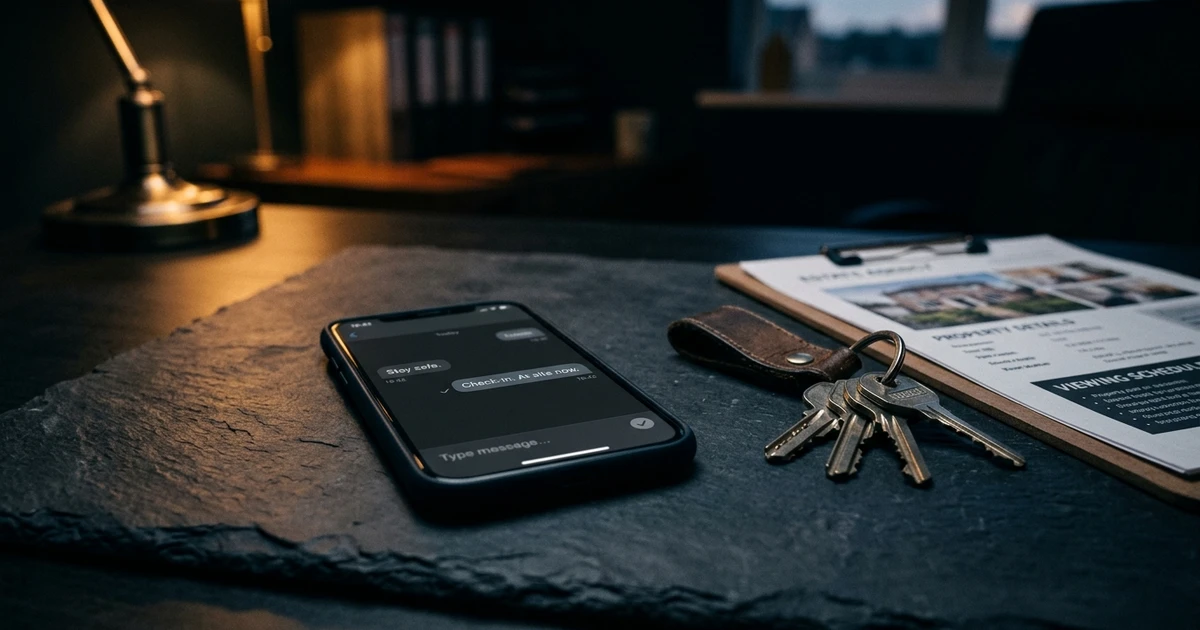
Think WhatsApp covers your lone worker safety? Think again — and it could cost you at a tribunal.
WhatsApp isn’t a defensible safety measure, it’s a chat app. Most estate agencies still rely on it to check on lone workers, but it was never built to protect them, and if something goes wrong, it gives you very little evidence that you took the right steps beforehand. The same gap applies to security services and courier and logistics teams.
From 30 October 2026, employers are liable for harassment of staff by clients unless they can prove they took “all reasonable steps” to prevent it. “We message the office” won’t cut it.
For estate and letting agents, who send people alone to meet strangers in empty properties every day, that changes everything. If an agent is harassed during a viewing and you can’t show you took those steps, you’re exposed to a tribunal claim.
The clock is already running.
Key Takeaways
- WhatsApp check-ins do not satisfy HSE guidance (INDG73) on managing lone workers, because they rely entirely on manual communication.
- The Worker Protection Act 2023 allows Employment Tribunals to increase compensation awards by up to 25% where employers failed to take reasonable preventative steps to prevent sexual harassment.
- From 30 October 2026, the Employment Rights Act 2025 raises that bar to “all reasonable steps” and makes employers directly liable for harassment of staff by third parties, such as clients — directly relevant to agents meeting the public alone.
- Industry surveys put the figures at 53% of UK estate agencies with no formal lone worker policy, and just 22% of agents feeling completely safe during property viewings.
- A dedicated lone worker system provides monitoring, escalation, incident reporting and evidence that informal messaging cannot.
Communication Is Not Monitoring
WhatsApp has become the default for many agencies. Message when you arrive. Message when you finish. Share your location if needed.
It’s free, familiar and convenient. But convenience is not compliance.
The real gap is what WhatsApp cannot do. It cannot prevent harassment from happening. It has no emergency prevention tools, no confidential reporting feature, and no way to raise an alarm with one touch.
If a viewing turns threatening, WhatsApp’s only option is for the employee to open the app, type a message, and send it. That takes presence of mind and the physical opportunity to type, and it’s well documented that neither is reliable in a genuine panic response.
A dedicated system with a one-touch alarm removes that requirement entirely. Help can be summoned with a single action, under stress, without needing to think or type.
WhatsApp allows people to communicate. A lone worker safety system is built to prevent, alert and respond — activating help the instant it’s needed rather than depending on the employee’s ability to compose a message under duress.
That distinction matters under HSE guidance, which expects employers to monitor lone workers, maintain contact, respond when contact is lost, manage emergencies, and review risk regularly.
Where the Gaps Show
- No automatic escalation. If a negotiator misses a check-in, WhatsApp generates no alert, notifies no supervisor, and starts no emergency procedure. Someone simply has to notice the silence.
- No structured audit trail. Following an HSE investigation, insurance claim or tribunal case, employers may need to show what procedures existed and how missed check-ins were handled. Scrolling through months of chat history rarely provides that evidence.
- No integrated emergency response. Timed check-ins, panic alarms, location sharing and incident logging are standard in dedicated systems, and simply outside WhatsApp’s design remit.
Why This Matters for Estate Agencies Specifically
Negotiators routinely conduct evening viewings, enter empty properties, and meet unfamiliar members of the public without support nearby. These are all foreseeable risks under a proper risk assessment.
The figures make the case starkly. Only 22% of estate agents feel completely safe during viewings. An estimated 150 lone workers are attacked every day in the UK. And a 2026 industry survey of 2,500 frontline lone workers found 56% had experienced verbal or physical abuse in the past 12 months.
The Legal Landscape Is Tightening
Since October 2024, the Worker Protection Act 2023 has required employers to take proactive steps to prevent sexual harassment of their staff, with tribunals able to increase compensation by up to 25% where preventative measures were lacking.
From 30 October 2026, the Employment Rights Act 2025 raises that standard to “all reasonable steps.” For the first time, employers become liable for harassment of staff by third parties, including customers, clients and members of the public.
This is a distinct legal strand from the general HSE lone-worker duty. But for estate agents meeting strangers alone in vacant properties, the two risks — physical safety and harassment — sit side by side in practice.
A tribunal is unlikely to ask whether staff used WhatsApp. It’s more likely to ask:
Was there a documented policy? Were risks formally assessed? Was there an effective monitoring process? What happened when someone failed to check in? Can you evidence that these procedures were followed consistently?
A Quick Compliance Check
Can your agency confidently answer:
- Do we have a documented lone worker policy, and does every employee know it?
- Have we assessed the risks of viewings, inspections and lone visits?
- Do we know when a check-in is missed, and does escalation happen automatically?
- Can staff discreetly request help if threatened?
- Can employees report concerns confidentially, and are incidents reviewed?
- Could we evidence our arrangements to the HSE, a tribunal, or our insurers?
If any of these are hard to answer, your current arrangements may not be proportionate to the risks your staff face. Compliance programmes typically take six to nine months to implement properly, so the window to act before 30 October 2026 is narrowing. For what a genuine alternative looks like, see our panic alarm apps guide, and for parking enforcement teams facing the same exposure.
How The Sentry Helps
The Sentry replaces manual messaging with a structured system built for lone workers in the property sector: timed check-ins, live GPS location sharing, one-touch panic alarms with automatic audio/video capture, confidential incident reporting, and full compliance documentation.
Technology can’t eliminate every risk of lone working. But it can make consistent procedures achievable, ensure a fast response when something goes wrong, and give employers the evidence that reasonable steps were genuinely in place.