
NHS Staff Survey 2025: Why Community Nurses Want Safety Standards
The 2025 NHS Staff Survey, published by NHS England on 12 March 2026, recorded the highest rate of physical violence against staff in three years: 14.47% of the 766,285 respondents said they’d experienced at least one incident of physical violence from a patient, relative or member of the public in the previous twelve months. For registered nurses and midwives specifically, the Royal College of Nursing put that figure at 22.6%, also the highest since 2022. Two months later, at RCN Congress in May 2026, district and community nurses stood up and asked for something more specific than another awareness campaign: national standards for lone working, not guidance, after members described encountering patients carrying knives and guns during home visits with no advance warning and limited support available.
For anyone leading a community health service, those two data points together, the freshest national violence figures on record and a live professional call for enforceable standards, are the clearest signal yet that lone working risk in this sector has moved from a background concern to a front-line workforce issue. If you’re building or refreshing your own lone working policy, this survey is exactly the kind of evidence that should shape it.
What the numbers actually say
The headline 14.47% figure sits inside a longer, uneven trend. Physical violence against NHS staff from patients, relatives or the public ran between roughly 14% and 15% for much of 2015 to 2022, dipped slightly, and has now risen again for two consecutive years, from 13.88% in 2023 to 14.38% in 2024 to 14.47% in 2025. Alongside it, 25.03% of staff reported harassment, bullying or abuse from patients or the public in the last 12 months, the highest on record, and 32.35% said they “often” or “always” feel burnt out because of their work, up from 31.51% in 2023. Ambulance staff remain the most exposed group by a wide margin, with reporting suggesting around half have experienced at least one violent incident in the year, but the survey doesn’t isolate community nursing as its own category, which is part of the problem this article addresses.
Why community and district nursing carries a distinct version of this risk
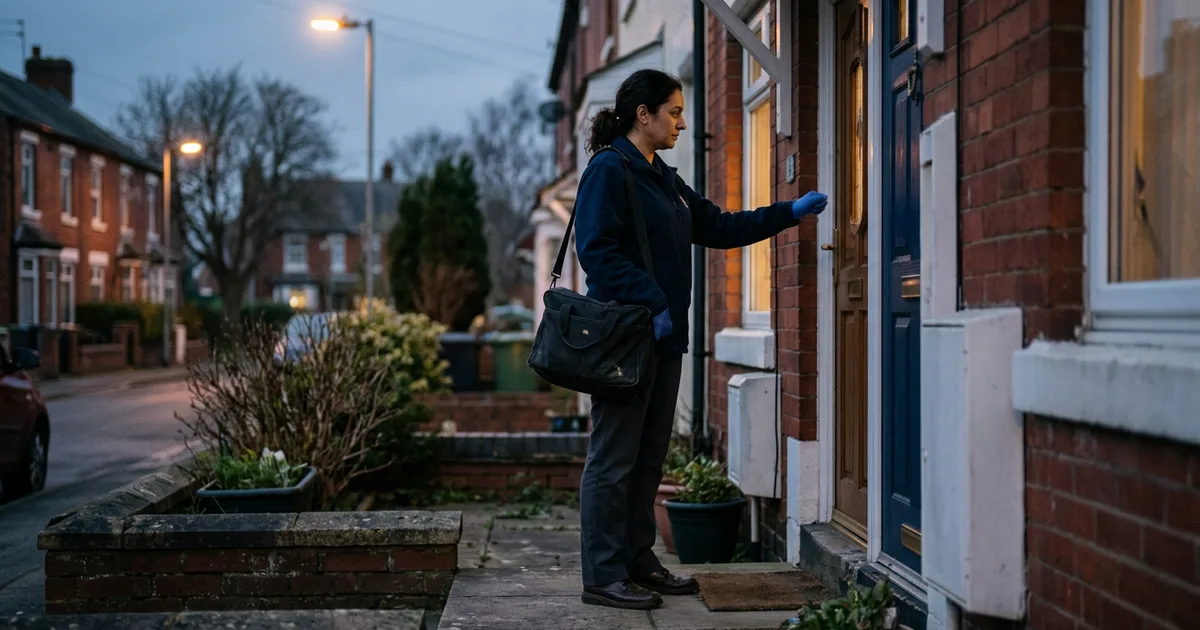
Hospital-based violence happens in a building with colleagues, security staff and CCTV nearby. Community nursing happens inside someone else’s home, alone, with none of that infrastructure. A district nurse, health visitor or community mental health worker doesn’t choose the environment, doesn’t know in advance what they’ll find behind the door, and often has no reliable way to summon help beyond a personal mobile phone.
This isn’t a new observation. An RCN survey of members working in the community as far back as 2015 found that 47.5% had experienced some form of abuse in the previous two years, with over 11% of those cases involving physical assault, and that only 22% of respondents said their manager always knew where they were during a lone home visit. What’s changed by 2026 is the tone of the response. Rather than repeating awareness guidance, RCN Congress delegates in May 2026 described specific incidents, including patients found to be carrying weapons during scheduled visits with no prior warning to the visiting nurse, and argued that safety in this setting should be treated as a right built into national standards, not something staff request case by case. One delegate summed up the asymmetry plainly: in almost any other profession, an employer wouldn’t send a lone woman into a stranger’s home with no backup as a matter of routine, yet that’s the default working pattern for much of community nursing.
The gap between guidance and an enforceable standard
Here’s the uncomfortable part for service leaders: there currently isn’t a single national lone working standard specific to community nursing, and the RCN’s Congress debate exists precisely because members don’t think general guidance has been enough. In the absence of that sector-specific standard, the legal floor is still the general one that applies to every employer: the Health and Safety at Work Act 1974, which requires risk to be assessed and controlled, and the Management of Health and Safety at Work Regulations 1999, regulation 3, which makes that assessment a specific, documented duty. Since October 2024, the Worker Protection Act 2023 has added a proactive requirement to take reasonable steps to prevent third-party harassment, backed by a 25% uplift on relevant tribunal awards, and the Employment Rights Act 2025 is expected to raise that bar further to an “all reasonable steps” standard, with commencement anticipated around October 2026.
In other words, service leaders don’t need to wait for a hypothetical future national standard to act. The existing legal duty already requires a documented, adequate lone worker risk assessment for home-visiting staff, and HSE’s own guidance (INDG73) is explicit that a standard mobile phone is not, on its own, an adequate control measure for a genuine lone working risk.
What this means for community health leaders right now
Three practical implications follow directly from this data:
- Treat the 2025 survey figures as a trigger for a fresh risk assessment, not just a statistic to cite in a board paper. A rising violence trend over two consecutive years is exactly the kind of change that should prompt employers to revisit existing control measures under MHSWR regulation 3.
- Don’t wait for a national community nursing standard to be published. The RCN’s ask is reasonable, but there’s no confirmed timeline for it, and your existing obligations under the Health and Safety at Work Act already apply in full today. The same principle applies to local authority social work and domiciliary care teams facing similar exposure.
- Close the specific gap the RCN identified: staff not knowing in advance what they’re walking into, and managers not reliably knowing where staff are during a visit. Both are addressable with the right process, independent of whatever national standard eventually emerges.
How The Sentry helps
The specific gap community nurses described at Congress, not knowing where a colleague is, and colleagues not knowing if something has gone wrong, is exactly what The Sentry is built to close. Live GPS tracking means a manager always has visibility of where a home-visiting team member is. Automated timed check-ins escalate automatically if a nurse doesn’t confirm they’re safe within the expected window after a visit, addressing the “only 22% of managers always knew” gap directly. If a visit does turn dangerous, a one-touch panic alarm, triggered from a widget on the home screen with no app to open and no login screen to navigate, alerts every contact the worker has nominated immediately, with their live location visible so colleagues can see who is responding and how close. Every incident is recorded through private, encrypted reporting, building the kind of evidence base that supports both immediate safeguarding and longer-term case for change. At £39.50 per user per year, with no hardware and deployment in under an hour, it’s a control measure community health services can put in place well ahead of any future national standard. See how this applies specifically to community healthcare on our community healthcare industry page.
Key dates
- 12 March 2026: 2025 NHS Staff Survey results published by NHS England.
- May 2026: RCN Congress debate calling for national lone working standards in community nursing.
- October 2024: Worker Protection Act 2023 proactive duty came into force.
- October 2026 (anticipated): Employment Rights Act 2025 “all reasonable steps” standard expected to commence.
Frequently asked questions
What percentage of NHS staff experienced violence in the latest survey? 14.47% of respondents to the 2025 NHS Staff Survey, published in March 2026, reported at least one incident of physical violence from a patient, relative or member of the public in the previous 12 months, the highest figure in three years.
Are community and district nurses more exposed than average? The national survey doesn’t break the figure out by community nursing specifically, but the Royal College of Nursing puts the figure for registered nurses and midwives at 22.6%, and its own historical research and Congress testimony point to distinct risks in home-visiting roles, particularly the lack of advance knowledge about a household and the absence of on-site support.
Has the RCN actually asked for new national standards? Yes. At RCN Congress in May 2026, district and community nurses called explicitly for national standards for lone working, arguing that current arrangements rely on inconsistent local guidance rather than an enforceable baseline.
Is a mobile phone enough to meet lone worker safety obligations? No. HSE guidance (INDG73) states clearly that a standard mobile phone is not, on its own, an adequate control measure for a genuine lone working risk, regardless of sector.
Do we need to wait for a new national standard before improving our own policy? No. Existing obligations under the Health and Safety at Work Act 1974 and the Management of Health and Safety at Work Regulations 1999 already require a documented, adequate risk assessment for lone-working staff, independent of any future sector-specific standard.
If your team’s home-visiting staff need better visibility and a faster way to raise the alarm, book a demo to see The Sentry in action.
This article was written by Stuart Evans, co-founder of The Sentry.