
HSE’s lone worker duty covers your whole facilities management team, whatever the role and whatever the shift
Facilities management (FM) contracts run on a genuinely mixed workforce: cleaners, security staff, porters and engineers, working days, evenings and nights across the same sites. HSE’s guidance treats all of them the same way. Its own overview lists lone workers as people working “as delivery drivers, health workers or engineers” and, in the same breath, “as security staff or cleaners.” No distinction by job title, and no distinction by shift or by how busy the building is — a cleaner working alone without a colleague nearby at 11am, with tenants and visitors moving through the building around them, carries exactly the same legal weight as one working alone at 11pm in an empty one, and exactly the same weight as an engineer on a reactive maintenance call.
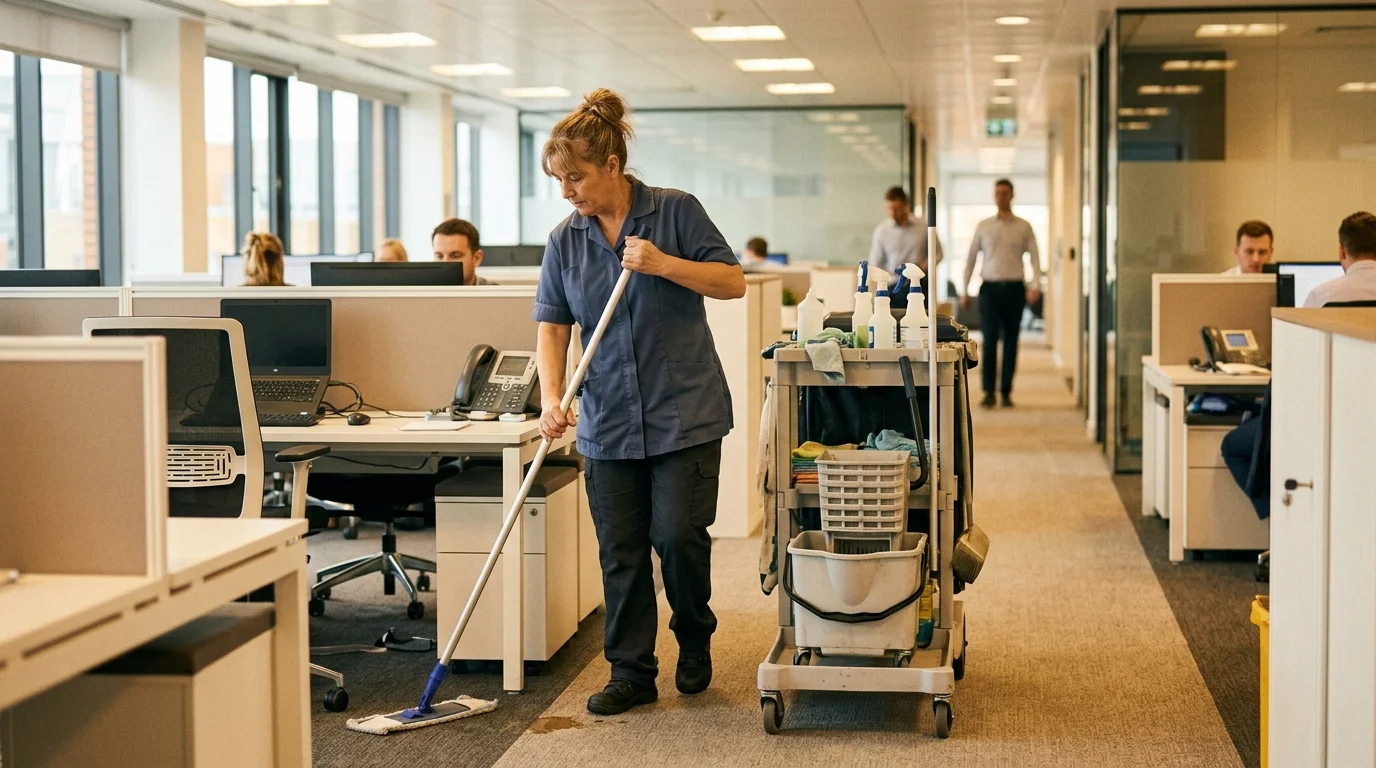
That matters because most FM lone worker policies we come across default to an engineering mental model — someone in a plant room, someone driving between sites — with cleaning, security and porterage added as an afterthought, and usually only considered at all once the site goes quiet. That’s a misreading of what “lone working” means. It isn’t about an empty building. A cleaner on a busy floor full of tenants, a security officer at a reception desk with visitors coming and going, and a porter working a different part of a site to the rest of the team are all lone workers if there’s no colleague or supervisor immediately on hand to help. Daytime lone working in these roles is just as real, and just as covered by the duty, as anything that happens after hours.
What HSE actually says about lone working
HSE’s core position is straightforward: employers must manage the health and safety risks of lone working before it happens, under the Health and Safety at Work etc. Act 1974 (sections 2 and 3) and the Management of Health and Safety at Work Regulations 1999 (regulation 3), which requires a suitable and sufficient risk assessment. HSE’s practical guidance document, INDG73 (“Protecting lone workers”), sets out what “suitable and sufficient” looks like in practice.
None of this is written with engineers in mind specifically. HSE’s own overview page names lone workers as anyone “who work by themselves without close or direct supervision” — and gives cleaners and security staff as examples in the same list as engineers, delivery drivers and health workers. That definition turns on supervision, not occupancy: a worker in a building full of other people is still a lone worker if nobody is immediately available to help them. What changes by role is the shape of the risk, not the existence of the duty.
Premises-based lone working: cleaners, porters and security
HSE draws a useful practical distinction, even if it isn’t a formal legal category: people working alone on a single site versus people travelling between sites. The first group — “premises-based” lone workers — covers a large chunk of a typical FM contract, and it isn’t defined by an empty building or a particular shift: a cleaner working a section of an occupied office floor with no colleague nearby, a security officer staffing a reception desk while visitors pass through, a porter on a different part of a busy site to the rest of the team, and — just as validly — anyone doing the same after most people have gone home. What makes each of them a lone worker isn’t how many other people are in the building; it’s the absence of a colleague close enough to help.
These roles share a common risk shape: if something happens — a fall, a medical episode, a confrontation — nobody is immediately on hand to notice or respond, whether or not the building is busy. Analysis of Crime Survey for England and Wales data ranks protective service occupations — security roles specifically — as the occupational group facing the highest risk of workplace violence of any group measured, which is worth knowing whatever the footfall on your contract’s sites.
Night shift patterns do bring one additional legal thread worth flagging alongside the lone-worker duty: the Working Time Regulations 1998 include specific provisions for night workers, including entitlement to a free health assessment. That’s a separate duty from lone-worker risk management, relevant specifically to overnight staff, so it’s worth tracking alongside — not instead of — the lone-worker risk assessment that applies to premises-based staff at any hour.
Away-from-base lone working: engineers and maintenance staff
The second group HSE’s guidance implicitly covers is people who don’t have a fixed base at all — field service engineers, mobile maintenance staff, inspectors moving between client sites through the day. The risk shape here is different again: less about extended isolation in one building, more about travel risk, unfamiliar sites, and — where the work involves plant rooms, risers or other enclosed spaces — the additional statutory framework of the Confined Spaces Regulations 1997.
It’s worth being precise here, because this is a place where FM employers can end up with a false sense of security. A lone worker check-in app is not a substitute for the hardware and procedural controls confined space entry actually requires under the 1997 regulations — gas monitoring, fall-arrest equipment where relevant, a standby person, and a rehearsed rescue plan. A check-in timer adds the communication layer: confirmation that someone knows a worker hasn’t checked in on schedule and can act on it. That’s a genuinely useful safety net for planned and reactive maintenance rounds, building access visits, and non-confined-space engineering work — it isn’t, and shouldn’t be sold as, a fix for confined space risk on its own.
The legal duty is the same — the risk assessment shouldn’t be
Here’s the practical consequence: because HSWA 1974 and MHSWR 1999 apply identically to a cleaner, a security officer and an engineer, an FM employer with a “lone worker policy” that only really describes the engineer’s world is carrying a documented gap for everyone else. HSE inspectors look for a risk assessment covering the actual population of lone workers an employer has — not the loudest or most visible group.
This gap concentrates most at smaller FM contractors, where an informal “text me when you’re done” arrangement stands in for a documented process across cleaning, porterage and security roles, even where the engineering side is more structured. That informal arrangement is unlikely to hold up as “suitable and sufficient” if it’s ever tested — whether by an HSE inspector during an investigation, in a prosecution, or scrutinised as part of an employment tribunal or civil claim.
What “all reasonable steps” looks like in practice for a mixed FM workforce
Building genuinely mixed provision doesn’t mean writing three separate policies. It means one lone worker risk assessment that honestly maps every role in your contract — premises-based and away-from-base — against the specific risk each one carries, and a corresponding set of controls that’s proportionate to each.
For a cleaner, porter or security officer working without a colleague nearby, whatever the hour or however busy the building is: a documented start/finish check-in with a clear escalation path if it’s missed. For a security officer specifically, the same, plus attention to the violence-risk profile the role carries. For an engineer on a maintenance round: the same check-in principle, with the honest acknowledgement that confined space entry needs additional, task-specific controls beyond it.
The looming Employment Rights Act 2025 “all reasonable steps” duty — anticipated to commence in October 2026 — raises the bar further, and it applies to every role in your contract, not just the ones with the most visible risk. See our full UK compliance framework for how this fits together, and how it compares to a genuine panic alarm app.
How The Sentry helps
The Sentry gives FM employers two complementary mechanisms across a mixed workforce, whatever the shift: a check-in timer for planned lone activity, and a one-touch panic alarm with automatic audio and video capture for the moment something actually goes wrong. Both work the same way whether it’s a cleaner on a busy occupied floor, a security officer between patrol points, or an engineer between reactive maintenance jobs.
The panic alarm’s recording matters beyond the immediate alert. It creates an objective record of what actually happened, rather than relying on one person’s account after the fact — and that cuts both ways. If a lone worker is accused of misconduct following a confrontation, the recording can support their version of events. If a lone worker is genuinely put at risk by someone else’s behaviour, the same recording can substantiate that instead. For FM roles with regular public or tenant contact — a security officer challenged at a reception desk, a cleaner confronted by someone on site — that two-way evidential record is often as valuable as the alert itself, for the employer investigating an incident and for the worker whose account might otherwise be their word against another’s.
The check-in timer isn’t a single fixed mode — employers choose how it’s used. It can run as active monitoring, with automatic escalation to a manager or nominated contact if a check-in is missed. Or, for lower-risk premises-based work where continuous monitoring isn’t proportionate, it can simply record arrival, departure and duration on site as a time-stamped, geo-located log, without an active escalation trigger attached. Which mode suits which role is a judgement for the employer’s own risk assessment, not something The Sentry decides for them.
It’s also worth being precise about what escalation actually delivers, whether triggered by a missed check-in or a panic alarm press. Neither requires a colleague to already be standing nearby — the point is that someone finds out quickly and can decide how to respond: calling emergency services, dispatching whoever’s genuinely closest, or attending themselves. On a large or unstaffed site, or where the nearest colleague is a manager offsite, that notification speed is the actual safety benefit — not a guarantee that physical help is seconds away. Employers should factor realistic response times into their risk assessment alongside the app, not instead of it.
We’re equally direct about where this fits and where it doesn’t. For confined space entry, The Sentry supports the communication element of your duty — it does not replace gas monitoring, fall-arrest equipment, a standby person or a rescue plan, all separately required by the Confined Spaces Regulations 1997. For premises-based and maintenance-orientated lone working — which covers most of a typical FM contract — it’s a straightforward, software-only way to close the documentation gap HSE’s guidance expects you to close.
Key dates and actions
- Now: Review whether your current lone worker risk assessment actually covers every role in your FM contract, not just engineers.
- Ongoing: Night shift staff — cleaners, porters, security — should be checked against Working Time Regulations 1998 night-worker provisions alongside lone worker risk controls.
- October 2026 (anticipated): Employment Rights Act 2025’s “all reasonable steps” duty is projected to commence — worth having mixed-workforce provision in place well ahead of that date, not scrambling to build it in September.
If you’re not sure whether your current lone worker provision actually covers your whole FM team, book a free demo and we’ll walk through what a mixed-workforce setup looks like. Also see how this applies to utilities and telecoms and construction and trades teams.
FAQ
Does HSE lone worker guidance apply to cleaners and security staff, not just engineers? Yes. HSE’s own guidance explicitly names security staff and cleaners as lone workers alongside engineers and delivery drivers, and the legal duty under the Health and Safety at Work etc. Act 1974 and the Management of Health and Safety at Work Regulations 1999 applies identically regardless of job title.
What’s the difference between “premises-based” and “away from base” lone working? Premises-based lone working covers people working alone on a single site — cleaners, security officers, some maintenance staff — whatever the hour. Away-from-base covers people travelling between sites, such as field engineers and inspectors. The risk profile differs; the legal duty to assess and manage it doesn’t.
Is a night porter or overnight cleaner covered by the Working Time Regulations as well as lone worker law? Yes. Night shift patterns can trigger separate duties under the Working Time Regulations 1998, including entitlement to a night-worker health assessment, alongside — not instead of — the lone worker risk assessment duty.
Do small FM contractors need a formal lone worker policy, or is a verbal arrangement enough? HSE guidance expects a documented, suitable and sufficient risk assessment regardless of employer size. An informal verbal arrangement, such as texting a manager when a shift ends, is unlikely to satisfy that standard if it’s ever challenged or investigated.
Which FM role faces the highest violence risk? Analysis of Crime Survey for England and Wales data ranks protective service occupations — security roles — as facing the highest risk of workplace violence of any occupational group measured, ahead of health and social care roles. That’s worth factoring into risk assessments for any FM contract that includes security patrols.
This article was written by Stuart Evans, co-founder of The Sentry.