
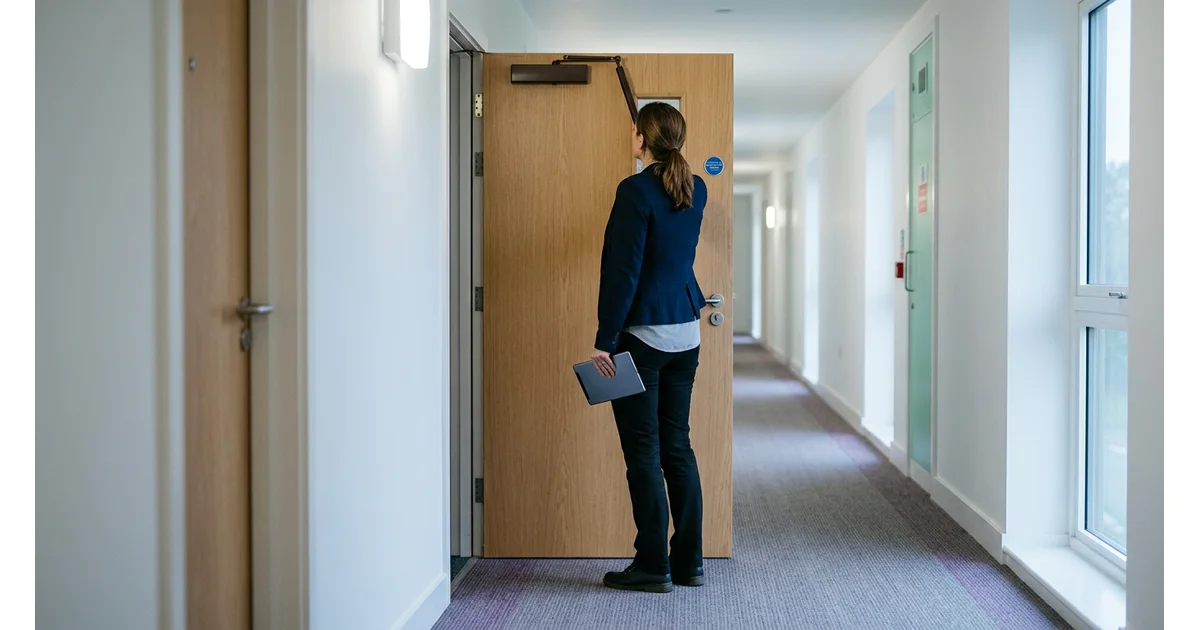
A fire safety duty that sends one person to every front door
In every block of flats in England above 11 metres, the Responsible Person must use best endeavours to check every flat entrance fire door at least once a year. In practice, that work is usually done by a block manager or property manager working alone, knocking on door after door and asking to be let in. It is a fire safety duty, but it creates a block manager lone working risk that many risk assessments may not address.
Summary: Regulation 10 of the Fire Safety (England) Regulations 2022 requires annual, best-endeavours checks of flat entrance fire doors in blocks above 11 metres. Each check means a lone visit to a resident’s home, sometimes repeated. Managing agents should risk assess these rounds, set check-in arrangements and record refusals and incidents as they happen.
Key Takeaways
- Regulation 10 of the Fire Safety (England) Regulations 2022 has been in force since 23 January 2023.
- In buildings with two or more homes above 11 metres, flat entrance fire doors must be checked on a best-endeavours basis at least every 12 months, and communal fire doors at least every 3 months.
- The duty sits with the Responsible Person under the Regulatory Reform (Fire Safety) Order 2005, but the visits are often delegated to managing agents and their staff.
- Employers of the staff carrying out the checks have separate duties under the Health and Safety at Work etc. Act 1974 to assess and control the risk of lone visits.
- Since 30 October 2026, the Employment Rights Act 2025 makes employers liable for third-party harassment within the Equality Act’s harassment provisions, including by residents, unless they took all reasonable steps to prevent it.
What Regulation 10 actually requires
The Fire Safety (England) Regulations 2022 were made to implement recommendations from the Grenfell Tower Inquiry, and most of their requirements came into force on 23 January 2023. Regulation 10 deals with fire doors.
For any building that contains two or more sets of domestic premises and is above 11 metres in height (measured to the top storey), the Responsible Person must:
- use best endeavours to check the fire doors at the entrances of individual flats at least every 12 months; and
- check any fire doors in communal areas at least every 3 months.
Responsible Persons must also give residents information about fire doors, including that they should be kept shut and that faults should be reported.
The Home Office fact sheet explains that the checks include self-closing devices, and that it is for the Responsible Person to decide how best to engage residents to get the access needed. Residents should be encouraged to allow access, but there is no simple power to insist on it, which is why the duty is framed as “best endeavours”. The regulations apply in England only.
What this means for block managers: the communal doors can be checked on a normal site visit. The flat entrance doors cannot. Checking both faces of a front door, including its closer and seals, generally means being let in by the resident, and that turns a compliance task into dozens of individual home visits.
Why flat door checks are a lone working task
A block manager’s ordinary site inspection takes place in common parts: stairwells, bin stores, plant rooms and car parks. Lone working risk there is real, but it is the kind most managing agents already think about.
Flat door checks are different. They take the manager to the threshold of each home, and often inside the hallway, to meet residents they may never have met before. Visits are frequently arranged at evenings or weekends to catch people at home, and a block with no-access flats will need repeat visits to show best endeavours.
The relationship context matters too. Many leaseholders meet their managing agent in person only rarely, and when they do, the conversation can quickly turn to grievances that have nothing to do with fire doors: service charges, major works, repairs, or noisy neighbours. Parliament’s Housing, Communities and Local Government Committee reported in May 2026 that regulation of managing agents is a necessary intervention, and a Westminster Hall debate in July 2026 heard extensive criticism of the sector from MPs. Whatever the merits of individual complaints, the person standing at the door when that frustration surfaces may be a single member of staff.
There are also the practical hazards of moving around a block alone: poorly lit corridors, stairwells with no signal, lifts that break down, and flats where the resident is vulnerable, unwell or hostile. Housing officers face similar risks during tenant visits.
What this means for block managers: a fire door round is a sequence of unplanned, one-to-one encounters with residents, in buildings where help may be several floors away.
Two duties, one visit
The fire door duty belongs to the Responsible Person, usually the freeholder, a resident management company or a right to manage company, and is often discharged through a managing agent. The safety of the person doing the checks belongs to their employer.
Under section 2 of the Health and Safety at Work etc. Act 1974, employers must protect their employees’ health, safety and welfare so far as is reasonably practicable. Regulation 3 of the Management of Health and Safety at Work Regulations 1999 requires a suitable and sufficient risk assessment. The Health and Safety Executive (HSE) is clear that working alone is not unlawful, but that the risks must be assessed and controlled. Our lone worker compliance guide outlines the wider duties and controls.
Harassment adds a further layer. In October 2024, employers became subject to a duty to take reasonable steps to prevent sexual harassment of their staff, including by third parties such as residents. Since 30 October 2026, the Employment Rights Act 2025 has strengthened that preventative duty to “all reasonable steps”. Separately, employers are now liable for third-party harassment related to protected characteristics covered by the Equality Act’s harassment provisions unless they took all reasonable steps to prevent it. General aggression unconnected to a protected characteristic remains a health and safety matter rather than an Equality Act one, so both frameworks need to be covered.
What this means for block managers: a fire door programme that records every door but says nothing about the safety of the person checking them meets only half of your duty of care. Lone worker compliance has to cover the people as well as the doors.
Making the flat door round safe
The structure of a fire door programme lends itself to sensible lone worker controls. The visits are planned, the addresses are known and the outcome of each visit is recorded anyway. The lone working policy template for housing officers provides a useful framework for planning visits.
1. Risk assess the round, not just the building. The building’s fire risk assessment covers the doors. A separate lone working risk assessment should cover the visits: time of day, building layout, known resident issues and how help would reach someone on an upper floor.
2. Use what you already know. Managing agents often hold information about flats with a history of complaints, disputes or aggression. Where it is lawful and proportionate to do so, flag those flats for a two-person visit or a different approach.
3. Set a check-in for each session. Someone in the office should know which block the manager is in, roughly how long the round will take and what happens if they do not confirm they are safe.
4. Agree what staff do when a conversation turns. Staff should have clear permission to end a visit, leave and record a no-access outcome rather than argue at the door. That decision can also support the best-endeavours record by documenting why access could not safely be gained.
5. Record refusals and incidents contemporaneously. A no-access log written up the next day loses detail. A time-stamped record made at the door, including any abuse or threats, is more useful for the fire safety file and for staff welfare.
6. Avoid single-handed evening rounds in large blocks. Where evening visits are necessary, consider pairing staff or arranging scheduled appointments rather than cold knocking.
Do you know where your block managers are during a fire door round? See how The Sentry supports block and property managers with timed check-ins and discreet alarms. Book a free demo.
How The Sentry supports block and property managers
The Sentry is a smartphone-only lone worker app with a web-based manager portal. It needs no hardware or IT integration, which suits managing agents with small teams covering many buildings. These features map most closely to the fire door round.
Check-in timer for the block. A manager starts a timed check-in on arrival. Depending on your risk assessment, it can run as a simple arrival and departure log or as active monitoring that escalates automatically if the manager does not check in on time. Read why WhatsApp check-ins alone are not a complete safety system.
Journey and location on the portal. Single check-ins are saved as geo-stamped, time-stamped entries. Longer sessions can track the manager’s movements on the portal map where location and connectivity permit. Indoor GPS accuracy may be limited. The app’s records can support, but cannot replace, fire door inspection and access-attempt records.
Silent and loud panic alarms. A one-touch widget on the home screen raises an alarm without opening the app (the phone must already be unlocked). The silent alarm records audio and video without an outward sign, which can help in a resident’s hallway; the loud alarm sounds a siren and records video. Nominated responders receive the manager’s available live location.
Incident reporting at the door. A manager can record an abusive exchange or threat on the spot, with dictated notes, photographs, time, date and location, routed to a named colleague. Reports can be submitted anonymously, leaving nothing stored on the device. A fire door refusal should also be recorded in the fire safety programme’s access-attempt log.
A reason to leave. The fake incoming call feature gives a manager a natural way to end a conversation that is going badly.
Find out how The Sentry protects property professionals on our estate and letting agents page, and see our social housing page for housing associations carrying out the same checks.
Key dates for block managers
- 23 January 2023: Regulation 10 of the Fire Safety (England) Regulations 2022 came into force.
- Every 3 months: communal fire door checks in blocks above 11 metres.
- Every 12 months: best-endeavours flat entrance fire door checks in blocks above 11 metres.
- 27 May 2026: HCLG Committee report concluded that regulation of managing agents is necessary.
- 30 October 2026: the strengthened “all reasonable steps” sexual harassment preventative duty and separate third-party harassment liability under the Employment Rights Act 2025 came into force.
Frequently Asked Questions
How often must flat entrance fire doors be checked? In a building with two or more homes that is above 11 metres in height, Regulation 10 of the Fire Safety (England) Regulations 2022 requires the Responsible Person to use best endeavours to check flat entrance fire doors at least every 12 months. Communal fire doors must be checked at least every 3 months. The requirement applies in England and has been in force since 23 January 2023.
What does “best endeavours” mean for flat door checks? It means the Responsible Person must make genuine, documented efforts to gain access, recognising that residents cannot always be compelled to let someone in. The Home Office says it is for the Responsible Person to decide how best to engage residents. Records of letters, appointments and visit attempts, including refusals, help show that best endeavours were used.
Who is responsible for the safety of the person doing the checks? Their employer. The fire door duty sits with the Responsible Person under the Regulatory Reform (Fire Safety) Order 2005, but if a managing agent sends its own staff, the managing agent must assess and control the risk of those visits under the Health and Safety at Work etc. Act 1974 and the Management of Health and Safety at Work Regulations 1999.
Can a block manager carry out flat door checks alone? Lone working is not unlawful, and many checks are done safely by one person. The risk should be assessed for each building and round, taking account of the time of day, layout, signal coverage and any known resident issues. Higher-risk flats may justify two people or a scheduled appointment, and every solo round should have a check-in arrangement.
Does the Employment Rights Act 2025 cover harassment by residents? Yes. Since 30 October 2026, employers are liable for third-party harassment of their staff related to protected characteristics covered by the Equality Act’s harassment provisions unless they took all reasonable steps to prevent it. Residents and leaseholders can count as third parties. Separately, the preventative duty for sexual harassment has required all reasonable steps since the same date.
Stuart Evans
Ready to protect your team? Every flat door check may mean a lone visit to a resident’s home. The Sentry helps your team monitor check-ins and arrange a response if a visit goes wrong. Book a free demo → | See pricing →