
The most dangerous part of a home survey is the part nobody sees
Residential surveyors spend much of their working week alone inside other people’s homes: climbing into roof spaces, walking through empty probate and repossession properties, and meeting occupants and their animals for the first time. Lone working for residential surveyors is not an occasional hazard; it is the job. Falls from height remain the leading cause of worker deaths in Great Britain, and a surveyor who falls in a loft with nobody expecting a call may not be found for hours.
Summary: Residential surveyors routinely work alone in lofts, vacant properties and occupied homes. RICS’s Surveying safely professional standard and HSE law both require firms to manage lone working risk. Firms should assess each inspection type, use timed check-ins with escalation, give surveyors a discreet alarm and record incidents and near misses consistently.
Key Takeaways
- Falls from height caused 31 of the 126 worker deaths in Great Britain in 2025/26, around a quarter of the total, according to HSE’s provisional statistics published on 1 July 2026. These are all-industry figures, not surveying-specific.
- Surveying safely (RICS, 2nd edition) became effective in February 2019 and was reissued as a professional standard in July 2023, applying to RICS-regulated firms and members.
- The Work at Height Regulations 2005 can apply to loft inspections from a ladder, alongside the general duties in the Health and Safety at Work etc. Act 1974.
- A timed check-in with a defined escalation route helps a firm notice when a lone surveyor is injured and unable to call for help; it does not detect a fall by itself.
- Since 30 October 2026, the Employment Rights Act 2025 makes employers liable for third-party harassment within the Equality Act’s harassment provisions unless they took all reasonable steps to prevent it.
Why residential surveying is a lone working job by design
Most residential inspections are carried out by one surveyor. The work is booked around vendors and occupiers, often in properties the surveyor has never seen, at addresses spread across a wide area. That pattern brings together three distinct risks that rarely appear on the same job sheet in other professions.
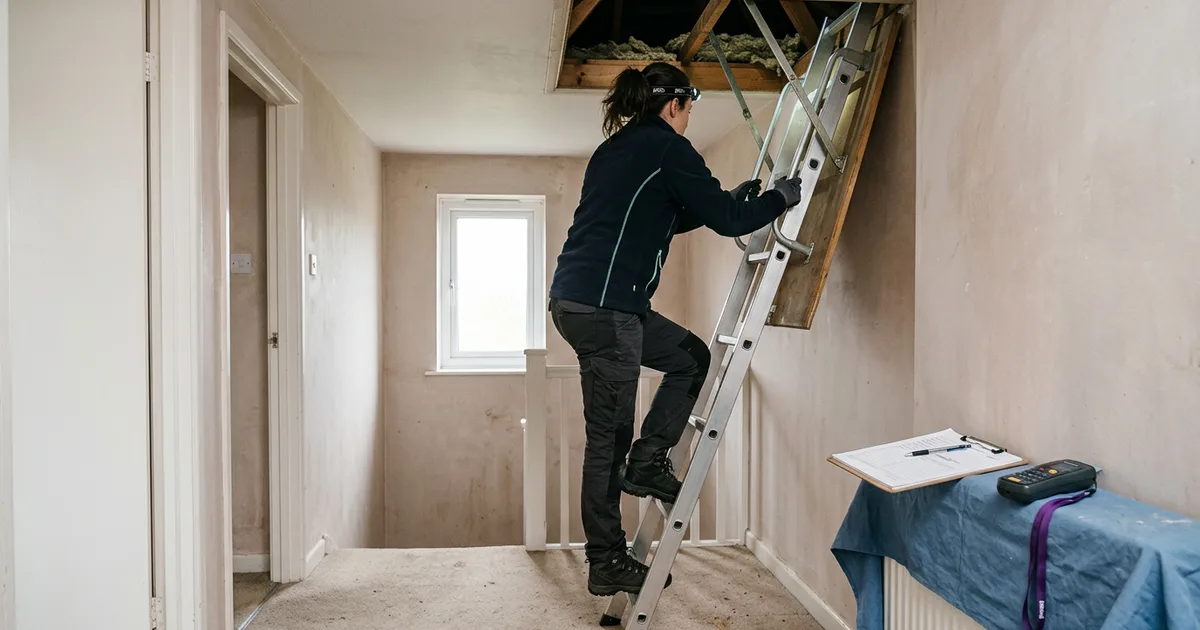
Height. Roof spaces are inspected wherever there is safe access, which usually means a loft ladder, a hatch and a torch. Joists, missing boards, hidden insulation and stored belongings make the space unpredictable, and the surveyor is usually the only person in that part of the house.
Empty buildings. Probate sales, repossessions and long-term vacant properties may have no power, damaged floors, poor lighting, or signs of unauthorised occupation. Nobody inside will notice if something goes wrong.
Occupants and animals. Occupied homes bring the opposite problem: unknown people and unknown dogs. The residential survey firm e.surv, for example, has publicly described a surveyor who was bitten by a dog during a routine inspection and drove himself to hospital, one of three dangerous incidents its surveyors reported within two months.
What this means for your firm: the hazards are not unusual in themselves. What makes them serious is that they are faced alone, often without anyone expecting a call until the end of the day.
Lofts and working at height
HSE’s provisional fatality statistics for 2025/26, published on 1 July 2026, recorded 126 worker deaths in Great Britain. Falls from height accounted for 31 of them, making it the most common cause of fatal injury once again. Most of those deaths occur in sectors other than surveying, but the underlying hazard can arise when a surveyor climbs into a roof void.
The Work at Height Regulations 2005 apply to work where a person could fall a distance liable to cause injury, including work from a ladder at a loft hatch where that risk exists. Employers must plan the work, ensure it is carried out by competent people, and make sure the equipment used is suitable. In practice, firms should have clear rules about when a surveyor should not enter a roof space at all, for example where the hatch is too small, there is no safe footing or the ladder is unsuitable.
The harder question is what happens if a fall does occur. A surveyor knocked unconscious, or unable to move, cannot raise an alarm themselves. Unless someone is expecting them to check in at a set time, nobody may know anything is wrong until a vendor returns home or the evening passes without contact.
What this means for your firm: the control for a fall is not only better ladders and clearer access rules. It is making sure someone notices quickly when a surveyor does not reappear.
Vacant homes and repossessions
Empty properties remove the safety net of other people. They may also have defects: failed electrics, rotten floorboards, broken glass, or stairs that have not been used for months. Some show signs of squatting or unauthorised entry, and a surveyor may not know until they are already inside.
There is no single dataset on incidents in vacant residential surveys, and firms should be wary of anyone who claims one. The risk assessment should treat vacant properties as their own category, with specific controls:
- Confirm the property’s status with the agent or lender before attending.
- Arrange key collection and return so that someone knows the surveyor is on site.
- Agree what the surveyor does if they find signs of occupation: leave, report and rebook, rather than investigate alone.
- Set a check-in time based on the size of the property, not a generic “end of day” call.
What this means for your firm: a vacant property should never be the visit where supervision is lightest, simply because there is nobody to meet. The broader UK lone worker compliance framework explains how risk assessments and practical controls work together.
Occupied homes, dogs and difficult conversations
Most occupiers are helpful. A minority are not, and surveyors are sometimes caught in the middle of disputes they did not create: a vendor unhappy with a valuation, a tenant who does not want the property sold, or an occupier who objects to access.
General aggression and threats are a health and safety matter under the Health and Safety at Work etc. Act 1974 and the Management of Health and Safety at Work Regulations 1999. Harassment related to a protected characteristic, including sexual harassment, also falls under the Equality Act 2010. In October 2024, employers became subject to a duty to take reasonable steps to prevent sexual harassment of their employees, including by third parties. Since 30 October 2026, the Employment Rights Act 2025 has strengthened that preventative duty to “all reasonable steps”. Separately, employers are now liable for third-party harassment related to protected characteristics covered by the Equality Act’s harassment provisions unless they took all reasonable steps to prevent it.
For a surveying firm, “third parties” includes vendors, occupiers and their visitors. Firms should make sure their policies say so, and that surveyors know they can leave a property and rebook without criticism.
Dogs deserve their own line in the booking process. Asking for animals to be secured before arrival is simple, and it should be recorded so that a surveyor who finds a loose dog has clear authority to stop the inspection.
Would your firm know promptly if a surveyor did not come down from a loft? See how The Sentry supports residential surveyors with timed check-ins and discreet alarms. Book a free demo.
What RICS expects from regulated firms
The Royal Institution of Chartered Surveyors (RICS) sets out its expectations in Surveying safely: health and safety principles for property professionals. The second edition was published in November 2018, became effective in February 2019 and was reissued as an RICS professional standard in July 2023, with no material change to the requirements. RICS describes appropriate health and safety management as a requirement for all RICS-regulated firms and members.
RICS’s health and safety checklist for home surveys points surveyors back to that standard and to their firm’s lone working policies, and it makes clear that every organisation should have adequate procedures in place for employees who work alone. In other words, RICS expects the firm, not the individual surveyor, to own the system.
For a small practice, that can feel like a lot of paperwork. In reality, a defensible lone worker compliance system for residential surveying comes down to a few questions an auditor, insurer or investigator would ask:
- Has each inspection type been risk assessed, including lofts, vacant properties and occupied homes?
- Does someone always know where each surveyor is and when they expect to finish?
- What happens if a surveyor does not check in?
- How does a surveyor raise an alarm discreetly in a confrontation?
- Are incidents and near misses recorded consistently, so the risk assessment can learn from them?
What this means for your firm: RICS membership is a mark of competence to clients. Meeting the health and safety standard behind it is part of the same duty of care.
How The Sentry supports residential surveyors
The Sentry is a smartphone-only lone worker app with a web-based manager portal. It needs no hardware, which matters for surveyors who already carry ladders, moisture meters and cameras. These are the features that map to the risks above.
Check-in timer with escalation. Before entering a property, the surveyor starts a timed check-in. Configured for active monitoring, a missed check-in escalates automatically to nominated colleagues. This helps a firm respond if a surveyor falls or becomes unwell and cannot raise the alarm themselves. The Sentry does not detect falls automatically, so firms should set check-in times that reflect the real length of each inspection. Read why informal WhatsApp check-ins are not a complete safety system.
Live location for responders. Single check-ins are recorded as geo-stamped, time-stamped entries; longer sessions also track the surveyor’s journey on the portal map, updating every 30 seconds where location and connectivity permit. If an alert is raised, responders see the surveyor’s available location rather than only a postcode from the diary. GPS reception may be limited indoors.
Silent and loud panic alarms. A one-touch widget on the home screen raises an alarm without opening the app (the phone itself must be unlocked). The silent alarm records audio and video without any outward sign; the loud alarm sounds a siren and records video. Recordings may support the surveyor’s account if an occupier later disputes what happened; handle them under your privacy and retention policies. See our guide to panic alarm apps for features to assess.
Incident and near-miss reporting. Surveyors can log a dog that was not secured, a broken loft board or an aggressive occupier on the spot, with dictated notes, photographs, time and location, routed to a named manager. Reports can be submitted anonymously, leaving nothing stored on the device.
A polite exit. The fake incoming call feature gives a surveyor a natural reason to step outside when a conversation is heading the wrong way.
See how The Sentry applies across surveying, architecture and building control on our surveying and building control page.
Key dates and references for surveying firms
- Work at Height Regulations 2005: apply where loft inspections involve a risk of a fall liable to cause injury.
- February 2019: RICS Surveying safely (2nd edition) became effective; reissued as a professional standard in July 2023.
- October 2024: employer duty to take reasonable steps to prevent sexual harassment came into force under the Worker Protection Act 2023.
- 1 July 2026: HSE published provisional 2025/26 fatality statistics (31 of 126 worker deaths from falls from height).
- 30 October 2026: the strengthened “all reasonable steps” sexual harassment preventative duty and separate third-party harassment liability under the Employment Rights Act 2025 came into force.
Frequently Asked Questions
Do residential surveyors count as lone workers? Yes. HSE defines lone workers as people who work by themselves without close or direct supervision, and most residential inspections are carried out by a single surveyor. That brings the firm’s duties under the Health and Safety at Work etc. Act 1974 and the Management of Health and Safety at Work Regulations 1999 into play, including a suitable and sufficient risk assessment for lone working.
What does RICS say about lone working? RICS’s Surveying safely professional standard sets out health and safety principles for RICS-regulated firms and members, and RICS’s home survey health and safety checklist directs surveyors to follow their firm’s lone working policies. It also makes clear that organisations should have adequate procedures to protect employees who work alone. Firms should be able to show what those procedures are and how they are used.
Is it safe for a surveyor to inspect a loft alone? It can be, with the right controls. The Work at Height Regulations 2005 require work with a risk of falling liable to cause injury to be planned and carried out by competent people with suitable equipment, and firms should set clear rules for when a roof space should not be entered. Because a fall can leave a surveyor unable to call for help, a timed check-in that escalates if missed is an important additional safeguard.
What should a surveyor do if they find signs of squatters in a vacant property? Leave, report it and rebook. A surveyor should not investigate alone, and the firm’s lone working policy should give them clear authority to stop the inspection. Record the incident safely and follow your firm’s procedures; do not stay to take photographs if it would put you at risk.
Does the Employment Rights Act 2025 apply to surveying firms? It applies to employers generally. Since 30 October 2026, the Act has required “all reasonable steps” under the preventative duty for sexual harassment. Separately, employers are liable for third-party harassment related to protected characteristics covered by the Equality Act’s harassment provisions unless they took all reasonable steps to prevent it. This can include harassment by vendors or occupiers. Both changes are now in force.
Stuart Evans
Ready to protect your team? Lofts, vacant homes and unfamiliar occupants are part of every residential surveyor’s week. The Sentry helps your team track visits and escalate missed check-ins so colleagues know when to respond. Book a free demo → | See pricing →