
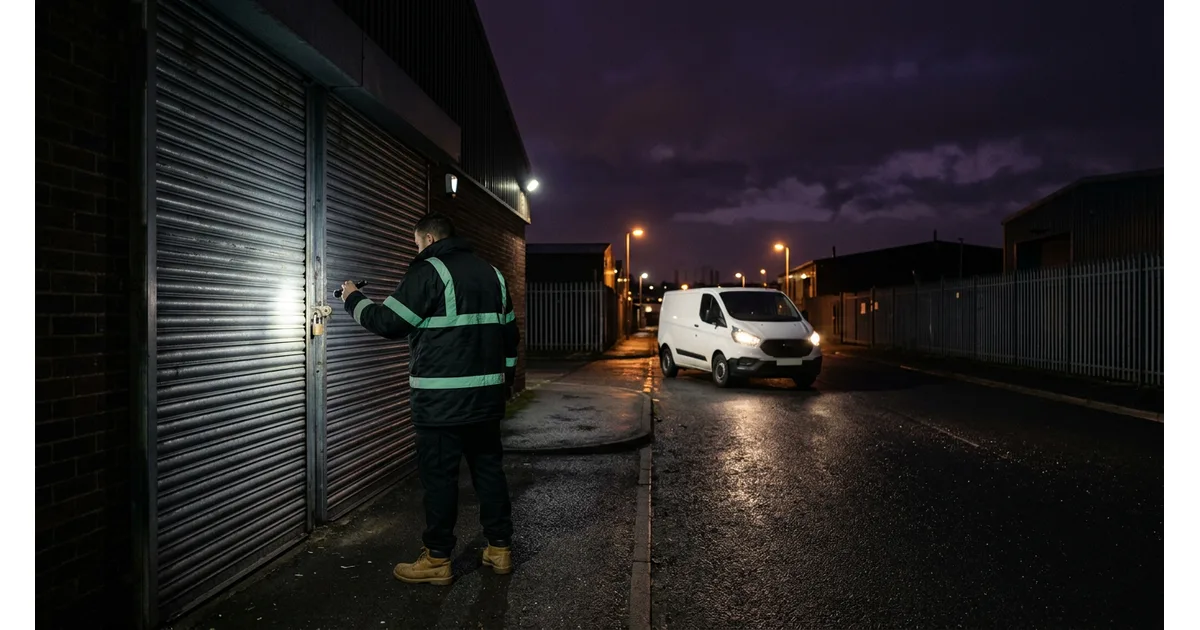
The regulator has put a number on it
Security guard lone worker safety now has an official baseline. In August 2026, the Security Industry Authority (SIA) published research showing that 43% of licence holders are dealing with increasing levels of violence at work, particularly in retail settings, and proposed new conflict management training in response. For security employers, the finding raises an awkward question: if the regulator can see violence rising, can you evidence what you do about it on a lone patrol at 3am?
The SIA’s own records will not answer that question for you. In a Freedom of Information response published in May 2026, the regulator said it is not the primary body investigating violence against security operatives, that many incidents are reported to the police and never reach the SIA, and that it does not record staff safety data from Approved Contractor Scheme audits. The evidence of how you protect officers working alone has to come from you.
Summary: SIA research published in August 2026 found 43% of licence holders face increasing violence at work. Security employers have a duty under the Health and Safety at Work etc. Act 1974 to assess and control lone working risks, and since 30 October 2026 face liability for third-party harassment. Mobile patrol and keyholding teams need check-ins, alarms, records and a fast route to nearby colleagues.
Key Takeaways
- SIA research with 1,442 licence holders found 43% are dealing with increasing violence at work, particularly in retail settings (SIA consultation, 28 August 2026).
- More than 450,000 people hold over 510,000 SIA licences, and new licence-linked qualifications, including revised conflict management content, are planned for 2027.
- The SIA does not record staff safety data from Approved Contractor Scheme audits, so employers must hold their own evidence of lone worker protection.
- Since 30 October 2026, the Employment Rights Act 2025 makes employers liable for harassment of staff by third parties, unless they took all reasonable steps to prevent it (SI 2026/1065).
- Martyn’s Law is expected to come into force in spring 2027, with the SIA as its regulator.
What the SIA’s research found
On 28 August 2026, the SIA opened a public consultation on changes to the qualifications behind every front-line licence. Alongside it, the regulator published a summary of independent research with 1,442 licence holders.
The headline finding for employers is that 43% of licence holders report having to deal with increasing levels of violence at work, with retail settings singled out. In response, the SIA is proposing changes to the conflict management skills specification so that security guarding training includes more real-life scenarios, and a new post-licence standard in advanced physical intervention skills for higher-risk deployments.
The consultation also proposes making an in-date first aid qualification a licence condition for door supervisors, security guards and close protection operatives, and adding awareness of Martyn’s Law to the training content. The SIA says the review will lead to new licence-linked qualifications in 2027. The consultation closed on 23 October 2026.
For context on scale, the SIA reports that more than 450,000 individuals hold over 510,000 SIA licences across the UK.
What this means for security employers: better training helps officers manage conflict and improves security guard lone worker safety at the margins, but it does not change what happens when an officer is alone and a situation goes beyond what training can fix. That is a lone working control, and it sits with the employer.
Why mobile patrols carry the sharpest lone working risk
Static guarding has its own risks, but mobile patrol, keyholding and alarm response work concentrates the factors that make lone working dangerous:
- Alarm response. An officer is sent, often alone, to a building where an alarm has activated, with no way of knowing whether intruders are still inside.
- Lock and unlock calls. Opening or securing premises at the quietest times of day.
- Vacant property inspections. Checking empty buildings, construction sites and void properties for damage or squatters.
- Patrol routes. Moving between multiple sites at night, sometimes miles from the nearest colleague.
- Retail and public-facing deployments. Where, as the SIA research suggests, violence is rising fastest; see lone working in retail.
The Health and Safety Executive (HSE) guidance Protecting lone workers (INDG73) names security staff among the groups who commonly work alone, and makes clear that a standard mobile phone is not adequate as a sole safety measure. Read more about HSE lone worker categories. Under the Health and Safety at Work etc. Act 1974 and the Management of Health and Safety at Work Regulations 1999, employers must assess these risks and put proportionate controls in place.
For contract security firms, the duty of care is shared but not diluted. The client controls the site; the security company remains the employer and remains responsible for its officers’ safety.
What this means for security employers: security guard lone worker safety starts with the rota. Every patrol route and every alarm response should have a defined check-in pattern, a way to raise an alarm discreetly and a plan for who responds.
The 30 October harassment duty applies to security staff too
Security officers deal with the public by design, which makes the Employment Rights Act 2025 directly relevant. The Employment Rights Act 2025 (Commencement No. 6 and Transitional and Saving Provisions) Regulations 2026 (SI 2026/1065) brought two key changes into force on 30 October 2026:
- Section 20: employers must take “all reasonable steps” to prevent sexual harassment of their employees.
- Section 21: employers become liable where a third party harasses an employee in the course of their employment and the employer failed to take all reasonable steps to prevent it.
For a guard on a retail or venue deployment, third parties include customers, members of the public and the client’s own visitors. The liability covers harassment related to protected characteristics, such as race, religion or belief, sex, sexual orientation and disability. The Security Industry Federation, a trade union for security workers, published survey findings in November 2025 identifying members of the public as a significant source of discriminatory abuse against officers.
Keep the frameworks separate. Physical violence or aggression with no link to a protected characteristic is a health and safety matter under the 1974 Act. Since 30 October 2026, racist or sexual abuse from a member of the public may also be an Equality Act 2010 matter, and can found a standalone tribunal claim against the employer. Most claims now have a six-month time limit, following a change that took effect on 1 October 2026.
What this means for security employers: your harassment policy, training and reporting route need to cover abuse from the public explicitly, and you need records that show they work.
BS 8484, police response and where an app fits
Many security buyers ask about BS 8484, the British Standard code of practice for the provision of lone worker services. It is worth being precise:
- BS 8484 is a code of practice, not a legal requirement.
- Police forces will give a priority response via a Unique Reference Number (URN) only where the whole chain, including the lone worker service and its alarm receiving centre (ARC), meets the relevant standards. The current version, BS 8484:2022, moved ARC monitoring requirements into BS 9518.
- Some contracts, clients or insurers specify a BS 8484 service with ARC monitoring for higher-risk roles.
The Sentry is not an ARC-monitored or BS 8484-certified service, and does not offer URN police response. Where a contract or your risk assessment requires that, The Sentry is not a substitute for it.
For most mobile patrol and keyholding teams, though, the fastest help is not a distant monitoring centre. It is the colleague on the next route or the neighbouring site, who may be minutes away. For those teams, and for security guard lone worker safety more broadly, an app that alerts nearby officers instantly, shows them exactly where their colleague is and records what happened can fill a gap that radios and phone calls leave open, often at a fraction of the cost of a device and ARC contract.
Running mobile patrols or keyholding? See how The Sentry alerts the officers nearest to a colleague in trouble, with live location and recorded evidence. Book a free demo.
What this means for security employers: match the tool to the risk assessment. Use ARC monitoring where it is genuinely required, and make sure every other officer has a fast, recorded way to call the colleagues best placed to reach them. For the practical alarm criteria, see what UK lone workers need from a panic alarm app.
How The Sentry helps security teams
The Sentry is a smartphone-only lone worker safety app, with no hardware and no IT integration. For security and mobile patrol work, the most relevant features are:
- Panic alarms from the home screen. A one-touch widget raises an alarm without opening the app (the phone must already be unlocked). A silent alarm records audio and video, useful when an officer cannot be seen to call for help; a loud alarm sounds a siren and records video.
- Instant alerts to the nearest colleagues. Nominated responders, typically fellow officers on nearby patrols and the duty supervisor, receive the alert with the officer’s live location on a map in the app. Any number of them can mark themselves as responding, each shown with a live line to the officer, so everyone can see who is on the way.
- Check-in timer for every site visit. An officer starts a timed check-in on arrival at an alarm call or vacant property. If they do not check in, it escalates automatically. The Sentry has no automatic fall or man-down detection, so the timer is the safeguard if an officer is injured or incapacitated.
- Live team map in the app. Officers and supervisors can see every checked-in colleague at once, so the nearest officer knows they are nearest before an alarm is ever raised.
- Journey tracking between sites. Longer check-ins record the officer’s location every 30 seconds, building a route trail.
- Incident reporting with evidence. Officers log incidents with notes (typed or dictated), photos, time and location, routed to a designated receiver. Reports can also be submitted anonymously, which supports reporting of abuse from the public.
- Manager portal for records. Managers assign and change licences and users, and review each officer’s check-ins, alarms and incident reports. Every record is mapped: a route trail for longer check-ins, and a single location for momentary check-ins and alarms.
- Two-way evidential protection. Alarm recordings support an officer’s account whether they are at risk or face an allegation about their own conduct.
An honest note on response. Because The Sentry alerts the colleagues you nominate rather than a monitored ARC, it works best where officers patrol or guard sites close enough to reach one another quickly, as is common in urban and multi-site patrol work. For truly isolated rural patrols, where the nearest colleague may be far away, plan the response route carefully in your risk assessment, and officers should still call 999 in an emergency.
For more on how the app supports guarding and patrol teams, see our page for the lone worker app for security services and mobile patrols.
Key dates
- 27 May 2026: SIA publishes its FOI response confirming it does not record staff safety data from ACS audits.
- 28 August 2026: SIA consultation opens, citing 43% of licence holders facing increasing violence.
- 1 October 2026: employment tribunal time limit rises from three to six months for most claims.
- 23 October 2026: SIA qualifications consultation closed.
- 30 October 2026: “all reasonable steps” sexual harassment duty and third-party harassment liability took effect (SI 2026/1065).
- Spring 2027 (expected): Martyn’s Law comes into force, with the SIA as regulator; new licence-linked qualifications due in 2027.
FAQ
Do security guards count as lone workers? Yes, often. The HSE’s lone worker guidance (INDG73) names security staff among those who commonly work alone, and mobile patrol, keyholding and alarm response officers frequently attend sites with no colleague present. Employers must assess and control these risks under the Health and Safety at Work etc. Act 1974 and the Management of Health and Safety at Work Regulations 1999.
What did the SIA’s 2026 research find about violence? Research with 1,442 licence holders, published alongside the SIA’s consultation on 28 August 2026, found that 43% are dealing with increasing levels of violence at work, particularly in retail settings. The SIA has proposed more realistic conflict management training and a new advanced physical intervention standard for higher-risk deployments, with new qualifications due in 2027.
Is BS 8484 a legal requirement for lone worker security? No. BS 8484 is a British Standard code of practice, not a law. It matters because police URN priority response is only available where the lone worker service and its alarm receiving centre meet the relevant standards, and some contracts or insurers require it. Where your risk assessment does not require ARC monitoring, a lone worker safety app that alerts nearby colleagues may be a proportionate control.
Who is responsible for a contract security officer’s safety on a client site? The security company, as employer, keeps its duty of care for its own officers under the Health and Safety at Work etc. Act 1974, even though the client controls the site. Clients also have duties to people on their premises, so the two should agree how risks are shared, but the employer cannot hand its own responsibility to the client.
Does the October 2026 harassment law apply to security staff? Yes. Since 30 October 2026, section 21 of the Employment Rights Act 2025 makes employers liable where a third party, such as a member of the public, harasses an employee in the course of their employment and the employer failed to take all reasonable steps to prevent it. This covers harassment related to protected characteristics, including race, sex and religion. Security firms should update policies, training and reporting routes to cover abuse from the public.
Stuart Evans
Ready to protect your team? The SIA has confirmed what your officers already know: violence is rising, and security guard lone worker safety needs evidence behind it. The Sentry gives every lone patrol and keyholding officer a discreet alarm and timed check-ins, and sends help from the colleagues closest to them. Book a free demo → | See pricing →