
Working in a team is not the same as being in sight of it
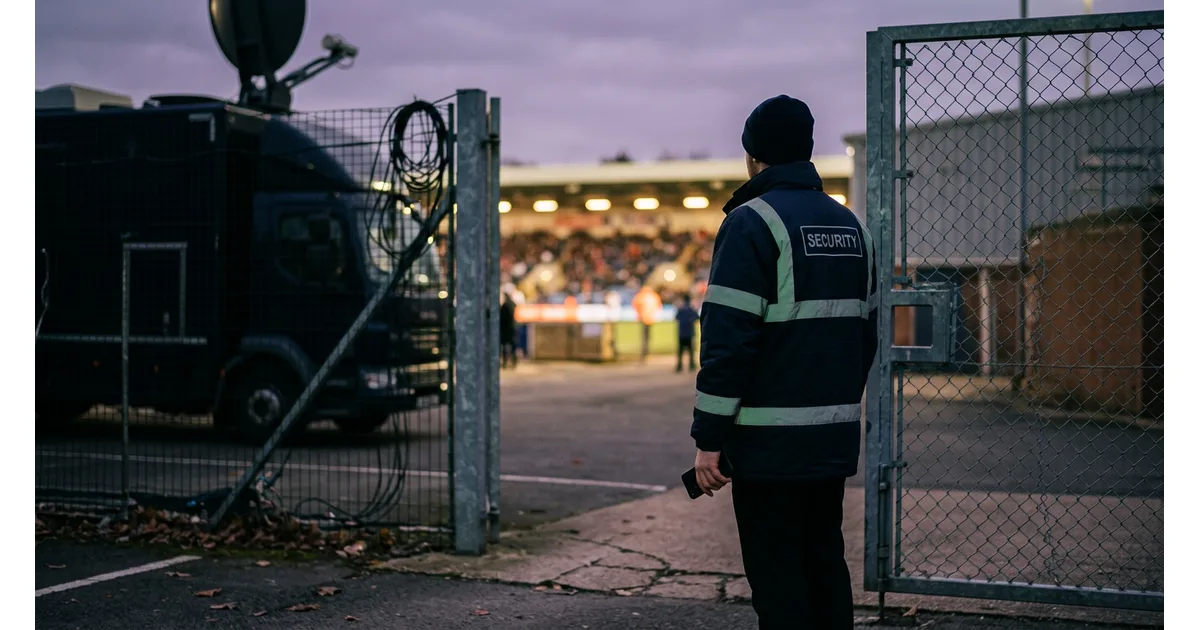
Event security teams are rarely alone, but individual officers often are. At a stadium, a festival site or an outside broadcast compound, a team of ten may be spread across gates, car parks, perimeters and equipment areas, each officer out of sight of the others. When one of them is threatened, the question is not whether help exists. It is whether the officer can call it, quietly, without making the situation worse.
The Health and Safety Executive (HSE) defines lone workers as people who work by themselves without close or direct supervision. On that definition, an officer posted alone at a service gate is working alone for that period, even though the rest of the team is on site.
Summary: Event and broadcast security teams are usually dispersed, so individual officers often face incidents out of sight of colleagues. Employers must assess that risk under the Health and Safety at Work etc. Act 1974. Since 30 October 2026, they must take all reasonable steps to prevent sexual harassment and face separate liability for third-party harassment unless they took all reasonable steps to prevent it. A silent alarm that alerts nearby teammates is a practical control.
Key Takeaways
- The HSE treats anyone working without close or direct supervision as a lone worker, which includes officers posted alone within a wider event team.
- Security Industry Authority (SIA) research published on 28 August 2026 found 43% of licence holders are dealing with increasing levels of violence at work.
- Since 30 October 2026, section 20 of the Employment Rights Act 2025 requires all reasonable steps to prevent sexual harassment. Separately, section 21 makes employers liable for third-party harassment unless they took all reasonable steps to prevent it (SI 2026/1065).
- Martyn’s Law (Terrorism (Protection of Premises) Act 2025) is expected to come into force in spring 2027, covering premises and events with capacity for 200 or more people, with the SIA as regulator.
- A silent alarm lets an officer summon nearby teammates without the person in front of them knowing that help is on the way.
Why dispersed teams carry their own risk
Event security work is organised in teams, but the team is spread across the whole site by design. Common positions include:
- Gates and turnstiles, where officers refuse entry, conduct searches and deal with people who have been turned away.
- Perimeters and fence lines, often in the dark and away from the main crowd.
- Car parks and compounds, including outside broadcast compounds full of valuable vehicles and equipment, which need guarding before, during and long after the event.
- Backstage, hospitality and production areas, where access disputes can become heated. See how venue and hospitality teams manage similar risks.
- Overnight build and break-down shifts, when the venue is almost empty and the team is thinly spread.
In each of these, an officer may be 200 metres from the nearest colleague and out of their line of sight. Noise, crowds and concrete stands make it hard to shout for help, and radio dead spots are common in large venues.
There is no reliable UK dataset on incidents involving dispersed event security officers, and we will not invent one. The wider picture is clear enough. The SIA’s August 2026 research on violence against security guards, carried out with 1,442 licence holders, found that 43% are dealing with increasing levels of violence at work. The regulator has responded by proposing more realistic conflict management training and a new advanced physical intervention standard for higher-risk deployments.
What this means for event security teams: your risk assessment should treat each isolated post as a lone working position, with its own way of summoning help, not as part of a team that is assumed to be nearby.
The legal duties that apply on event days
Health and safety. Under the Health and Safety at Work etc. Act 1974 and the Management of Health and Safety at Work Regulations 1999, the security company, as employer, must assess the risks to its officers and put proportionate controls in place. The event organiser and venue have their own duties to people on site, but the security firm cannot hand its duty of care for its own officers to the client. HSE guidance on lone working (INDG73) also makes clear that a standard mobile phone is not adequate as a sole safety measure.
Harassment by the public. The Employment Rights Act 2025 (Commencement No. 6 and Transitional and Saving Provisions) Regulations 2026 (SI 2026/1065) brought two changes into force on 30 October 2026:
- Section 20: employers must take “all reasonable steps” to prevent sexual harassment of their employees.
- Section 21: employers become liable where a third party, such as a member of the public or an event guest, harasses an employee in the course of their employment and the employer failed to take all reasonable steps to prevent it. This covers harassment related to protected characteristics, including race, religion or belief, sex, sexual orientation and disability.
Event crowds, alcohol and refusals at the gate make this a live risk for security teams. Keep the frameworks distinct, though: physical aggression with no link to a protected characteristic is a health and safety matter, while since 30 October 2026 racist or sexual abuse from a member of the public may also ground a standalone tribunal claim against the employer. Most claims now have a six-month time limit, from 1 October 2026.
Licensing. The SIA’s guidance is that stewards need a door supervisor licence to guard against disorder, damage or unauthorised access at premises licensed for alcohol or regulated entertainment, and a security guard licence for contracted guarding elsewhere. In-house staff at certified sports grounds in England and Wales are exempt.
What this means for event security firms: with the changes now in force, a tribunal is likely to ask what you did to protect officers from abuse by the public, and whether officers had a realistic way to raise the alarm.
Martyn’s Law will raise the bar further
The Terrorism (Protection of Premises) Act 2025, known as Martyn’s Law, received Royal Assent on 3 April 2025 and is expected to come into force in spring 2027, with the SIA as regulator. Premises and events expected to hold 200 or more people will need public protection procedures covering evacuation, invacuation, lockdown and communication. Enhanced duties apply at 800 or more.
Martyn’s Law is about terrorism preparedness rather than officer safety, but it pushes in the same direction. Venues will expect their security teams to communicate quickly, know where every team member is and keep records. The SIA is also proposing to add awareness of Martyn’s Law to licence-linked training.
The Purple Guide, the industry guidance on event safety published by the Events Industry Forum, updated its crowd management chapter in January 2026. It treats communication systems and management structure as core parts of crowd management planning.
What this means for event security firms: clients will increasingly ask how your officers communicate and raise alerts. Being able to show it, with records, is becoming part of winning contracts.
Why the silent alarm matters most
Most event teams rely on radios, and radios remain essential. But a radio call has one weakness in a confrontation: everyone can hear it, including the person the officer is dealing with. Keying a radio and asking for backup can escalate a tense moment, prompt someone to run with stolen kit, or make an aggressor act before help arrives.
A silent alarm helps address that problem. The officer triggers it discreetly, the team is summoned, and the person in front of them does not know that the call has gone out. The officer can keep talking calmly, keep the situation steady and buy time while colleagues close in from across the site.
This matters in situations event teams know well:
- A group refused entry at the gate who will not leave.
- Someone found inside an outside broadcast compound or production area who should not be there.
- A guest becoming aggressive or sexually abusive in a hospitality area.
- An officer on an overnight shift who disturbs someone near the equipment.
The Sentry’s silent alarm also records audio and video, so what happened is captured from the officer’s point of view. That protects the officer whether they have been assaulted or are later accused of using excessive force.
Do your officers work out of sight of each other? See how The Sentry’s silent alarm summons the nearest teammates without alerting the aggressor. Book a free demo.
What this means for event security teams: give officers a way to call for help that does not announce itself. It is often the safest option in the moment, and the strongest evidence afterwards.
How The Sentry helps event security teams
The Sentry is a smartphone-only lone worker safety app, built around colleagues coming to each other’s aid. That suits event and broadcast teams, where the fastest help is usually a teammate a few hundred metres away. The most relevant features are:
- Silent alarm. Triggered from a one-touch home screen widget, without opening the app (the phone must already be unlocked). There is no siren. It alerts the team instantly and records audio and video, while the person causing the problem has no idea help is coming.
- Loud alarm. Where drawing attention will help, a siren sounds and video is recorded.
- Alerts to the nearest teammates. Every nominated team member receives the alert with the officer’s live location on a map in the app. Any number of them can mark themselves as responding, each shown with a live line to the officer, so the team can see who is on the way and from where.
- Live team map in the app. Officers and supervisors can see every checked-in colleague across the site, so the nearest officer knows they are nearest.
- Check-in timer for isolated posts. For overnight compound guarding or remote perimeter posts, an officer starts a timed check-in. If they do not check in, it escalates automatically. The Sentry has no automatic fall or man-down detection, so the timer is the safeguard if an officer is injured.
- Incident reporting. Officers log incidents, including abuse from the public, with notes (typed or dictated), photos, time and location. Reports can be submitted anonymously, supporting the reporting steps expected under the new harassment duty.
- Manager portal for records. Managers assign and change licences and users, and review each officer’s check-ins, alarms and incident reports. Each record is mapped, so you can show a client or a tribunal exactly what lone worker protection was in place, what happened and where.
The Sentry works alongside radios rather than replacing them. It is not a monitored alarm receiving centre service and does not provide police URN response, so officers should still call 999 in an emergency. Because help comes from teammates, it works best where officers are deployed close enough to reach one another, which is the normal pattern at events.
See how the app supports guarding, patrol and event teams on our page for the lone worker app for security services.
Key dates
- 26 October 2024: Worker Protection Act 2023 duty to take reasonable steps to prevent sexual harassment comes into force.
- 28 August 2026: SIA consultation published, citing 43% of licence holders facing increasing violence.
- 1 October 2026: employment tribunal time limit rises from three to six months for most claims.
- 30 October 2026: “all reasonable steps” sexual harassment duty and third-party harassment liability took effect (SI 2026/1065).
- Spring 2027 (expected): Martyn’s Law comes into force, subject to confirmation by the Home Office; new SIA licence-linked qualifications due in 2027.
FAQ
Are event security officers lone workers if they work in a team? They can be. The HSE defines lone workers as people who work by themselves without close or direct supervision. An officer posted alone at a gate, perimeter or compound, out of sight of colleagues, is working alone for that period, so the employer should assess that position as a lone working risk.
Why use a silent alarm instead of a radio? Radios remain essential for running an event, but a radio call can be heard by the person an officer is dealing with, which may escalate the situation. A silent alarm summons nearby teammates without the aggressor knowing help is on the way, and it records audio and video as evidence. The two work best together.
Does the October 2026 harassment law apply to event security? Yes. Since 30 October 2026, section 21 of the Employment Rights Act 2025 makes employers liable where a third party, such as a member of the public, harasses an employee in the course of their employment and the employer failed to take all reasonable steps to prevent it. This covers harassment related to protected characteristics such as race, sex and religion. Event security firms should update their policies, training and reporting routes accordingly.
Who is responsible for the safety of contracted event security officers? The security company, as employer, keeps its duty of care for its officers under the Health and Safety at Work etc. Act 1974. The event organiser and venue have their own duties to people on site, so the parties should agree how risks are shared, but the employer cannot pass its own responsibility to the client.
How does Martyn’s Law affect event security teams? Martyn’s Law is expected to come into force in spring 2027 and applies to premises and events expected to hold 200 or more people, with enhanced duties at 800 or more. It requires public protection procedures, including communication, and the SIA will regulate it. In practice, venues will expect security teams to communicate quickly and keep records, which a team alerting app can support.
Stuart Evans
Ready to protect your team? Your officers work as a team, but incidents happen out of sight. The Sentry’s silent alarm brings the nearest teammates running without tipping off the aggressor, and keeps a record of every alert. Book a free demo → | See pricing →