
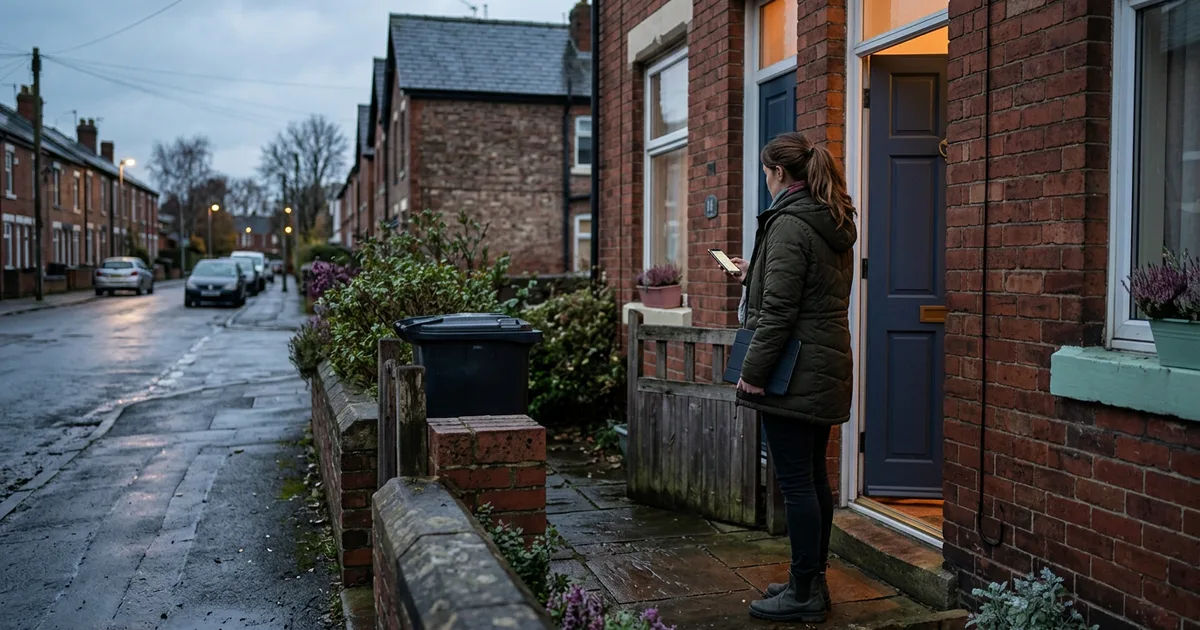
Possession is now an argument, and your staff are the ones standing on the doorstep
Since 1 May 2026, landlords in England can no longer serve new Section 21 notices to end a tenancy. For new possession notices, landlords now rely on a Section 8 ground and must prove that ground in court if the tenant does not leave. That shift has quietly changed letting agent lone working safety: the routine inspection, the arrears conversation and the “we need to talk about the tenancy” visit are now the moments where a contested case is built, and they are usually carried out by one member of staff, alone.
Summary: The Renters’ Rights Act 2025 abolished new Section 21 notices from 1 May 2026, so new possession cases depend on evidenced Section 8 grounds. Inspections, arrears visits and notice-related contact may be contested and emotionally charged. Agencies should review lone working risk assessments, escalation routes and incident records for these specific visits now.
Key Takeaways
- New Section 21 “no fault” notices could not be served from 1 May 2026; existing assured shorthold tenancies in England moved to periodic assured tenancies on that date under the Renters’ Rights Act 2025. Transitional rules apply to valid earlier notices.
- The mandatory rent arrears ground (Ground 8) now requires at least 3 months’ arrears, with 4 weeks’ notice, so arrears conversations may run longer and carry more at stake.
- Landlords must give 4 months’ notice to move in or sell (Grounds 1 and 1A), and cannot use either ground in the first 12 months of a tenancy.
- Under the Health and Safety at Work etc. Act 1974 and the Management of Health and Safety at Work Regulations 1999, employers must assess and control the risk of these visits, whoever owns the property.
- From 30 October 2026, a new duty to prevent third-party harassment of staff is widely reported to take effect under the Employment Rights Act 2025, although the commencement order had not been published at the time of writing.
What actually changed on 1 May 2026
The Renters’ Rights Act 2025 received Royal Assent on 27 October 2025, and its first phase came into force on 1 May 2026. From that date, existing fixed-term assured shorthold tenancies converted to periodic tenancies, and landlords lost the ability to serve new Section 21 notices.
For new notices, landlords must rely on one of the grounds in Schedule 2 to the Housing Act 1988, as amended. The government’s guide is plain about the burden: if a tenant does not leave, the landlord must go to court and provide evidence that the ground is met. Valid Section 21 notices served before 1 May remain subject to transitional rules.
Some of the key grounds letting agents will now see in practice:
- Ground 8 (rent arrears, mandatory): at least 3 months’ arrears (or 13 weeks where rent is paid weekly or fortnightly), both when notice is served and at the hearing. Notice period: 4 weeks.
- Grounds 1 and 1A (landlord moving in or selling): 4 months’ notice, and not available in the first 12 months of a tenancy.
- Ground 13 (deterioration of the property, discretionary): 2 weeks’ notice, but it needs evidence of the property’s condition.
- Ground 14 (anti-social behaviour, discretionary): proceedings can begin immediately, and the ground expressly covers nuisance or annoyance caused to “a person employed in connection with housing management functions”.
That last point matters. The law explicitly recognises that the people managing a tenancy can be on the receiving end of a tenant’s behaviour.
What this means for your agency: Section 8 cases depend on evidence, and much of that evidence is gathered by your staff in person, in occupied homes.
Why this raises the risk of a routine visit
Most letting agency visits were never risk-free. What has changed is the emotional temperature of them. A tenant who knows that Ground 13 depends on the condition of the property, or that Ground 8 depends on an arrears figure, may view an inspection as the first step in losing their home.
Consider the visits your property managers now carry out:
- Mid-tenancy inspections that may later be relied on to prove deterioration.
- Arrears visits where the figure is close to the 3-month threshold.
- Pre-sale or move-in conversations, where a landlord has decided to use Ground 1 or 1A and the tenant has 4 months to find a new home.
- Follow-up visits after complaints, including disputed repairs, where the tenant feels unheard.
Each of these puts one member of staff, usually alone, inside a home where the occupant may feel their housing is under threat. Tenants knowing their rights is a good thing; it does, however, mean that disagreements about notice periods, arrears figures or the condition of a property are more likely to be argued out face to face, with the property manager as the person in front of them.
Research by Propoly, reported by The Negotiator in June 2026, found complaints against letting agents rose from 2,863 in 2024 to 4,220 in 2025, an increase of 47.4%, and its chief executive expects the Act to accelerate that trend. Complaints are not assaults, and these figures do not establish an increase in violence; they do underline why agencies should plan for difficult conversations.
What this means for your agency: a visit that was “low risk” in 2025 may not be low risk now. Your risk assessment should be reviewed against the new possession process, not simply carried forward.
Your legal duty has not moved, but the risk it covers has
The Health and Safety Executive (HSE) is clear that employers have the same duty of care to lone workers as to anyone else. Section 2 of the Health and Safety at Work etc. Act 1974 requires employers to protect the health, safety and welfare of employees so far as is reasonably practicable, and Regulation 3 of the Management of Health and Safety at Work Regulations 1999 requires a suitable and sufficient risk assessment. Our UK compliance guide explains the wider framework.
“Suitable and sufficient” is the important phrase. A risk assessment written before 1 May 2026, describing inspections as routine property checks, may no longer reflect what those visits involve. If a member of staff is hurt during an arrears visit, the agency should be able to show that it identified the risk and selected proportionate controls.
There is a second, separate strand. Harassment related to a protected characteristic under the Equality Act 2010 is governed by a different framework from general aggression. Since October 2024, employers have had a duty to take reasonable steps to prevent sexual harassment of their staff, including by third parties such as tenants. The Employment Rights Act 2025 strengthens this to “all reasonable steps”, and adds a broader duty covering harassment by third parties across protected characteristics. The government has announced 30 October 2026 as the start date, and that date is widely reported, but the commencement order had not been published at the time of writing. Read our guide to the anticipated harassment law changes for the separate employment-law obligations.
It is worth keeping the two strands distinct. A tenant who threatens a property manager over an arrears figure is a health and safety matter. Sexual harassment during an inspection engages the Equality Act duty as well. Your lone worker compliance arrangements need to address both.
What this means for your agency: the law expects your controls to match the visit. If the visit has changed, the controls should too.
Practical steps for letting agents this quarter
None of this requires reinventing your lettings process. It does require looking at your lone worker protection arrangements through the lens of who is in the room and what is at stake for them.
1. Re-grade your visit types. Separate standard inspections from visits connected to a live dispute, an arrears figure or a possession ground. The second group should carry stronger controls by default.
2. Decide when two people attend. Some visits should not be done alone at all, for example where there is a history of aggression or an anti-social behaviour report. Write that threshold down so the decision is not left to a busy branch on the day.
3. Agree a timed check-in for every solo visit. Someone in the office should know where the property manager is, when they are expected to finish and what happens if they do not confirm they are safe. HSE’s guidance is clear that a mobile phone on its own is not an adequate control; see why WhatsApp check-ins are not a complete lone worker system.
4. Give staff a discreet way to call for help. An obvious emergency call can escalate a tense situation. A silent alert that shares location without drawing attention is a different tool.
5. Record what happens, contemporaneously. Incidents and near misses written up the next morning lose detail. Notes, photographs, times and locations captured on the spot are more useful to your agency and to your staff member. Follow your evidence-handling and privacy procedures before using recordings or photographs.
6. Brief staff on the new grounds. People handle hard conversations better when they understand them. A property manager who can explain the 4-month notice period clearly is less likely to be drawn into an argument about it.
Are your property managers still treating every inspection the same way? See how The Sentry supports letting agent lone working safety across inspections, arrears visits and viewings. Book a free demo.
How The Sentry supports letting agents under the new regime
The Sentry is a smartphone-only lone worker app built originally for estate and letting agents, with a manager portal for branch and head office oversight. For agencies searching for a lone worker app for letting agents, these are the features that map most closely to the risks above.
Check-in timer for each visit. A property manager starts a timed check-in before an inspection or arrears visit. Depending on your risk assessment, it can run as a simple arrival and departure log or as active monitoring with automatic escalation if the check-in is missed. Every check-in is recorded as a geo-stamped, time-stamped entry in the manager portal.
Silent and loud panic alarms. A one-touch widget on the phone’s home screen raises an alarm without opening the app (the phone itself must already be unlocked). The silent alarm gives no outward sign and records audio and video; the loud alarm sounds a siren and records video. Nominated responders receive the worker’s live GPS location, and responders can mark themselves as responding.
Evidence that protects both sides. Alarm recordings may support an employee’s account whether they were put at risk or later accused of misconduct. Recordings should be handled in line with your privacy and evidence-retention policies.
Incident reporting on the spot. Staff can log an incident in the app with typed or dictated notes, photographs, time, date and location, routed to a designated manager. Reports can also be submitted anonymously, leaving nothing stored on the device, which helps staff raise concerns they might otherwise keep to themselves.
A way out of a conversation. The fake incoming call feature plays a ringtone, giving a property manager a natural reason to step outside.
The Sentry needs no hardware and no IT integration, and a branch can be set up in under an hour. You can see how it applies across viewings, valuations and lettings on our estate and letting agents page.
Key dates for letting agents
- 27 October 2025: Renters’ Rights Act 2025 received Royal Assent.
- 1 May 2026: New Section 21 notices abolished; existing assured shorthold tenancies became periodic; revised Section 8 grounds in force, subject to transitional provisions for earlier notices.
- 31 May 2026: deadline for landlords to give existing tenants the government’s information sheet.
- 30 October 2026 (widely reported): “all reasonable steps” duty and third-party harassment duty under the Employment Rights Act 2025, subject to the commencement order being made.
- Later phases: the Private Rented Sector Database, the Landlord Ombudsman and the Decent Homes Standard for private renting are due to follow, with dates still to be confirmed.
Frequently Asked Questions
Can a letting agent still use Section 21? New Section 21 notices could not be served in England from 1 May 2026, when the main tenancy reforms in the Renters’ Rights Act 2025 came into force. Landlords must now use one of the Section 8 grounds in the Housing Act 1988, as amended, and prove that ground in court if the tenant does not leave. Notices served validly before 1 May 2026 are subject to transitional rules.
Why does the end of Section 21 affect staff safety? Because new possession cases depend on evidence, and much of that evidence comes from visits made by letting agency staff. Inspections may later support a deterioration ground, and arrears conversations may relate to a mandatory ground. Tenants who see a visit as a step towards losing their home may become distressed or confrontational, and those visits are often made by one person alone.
Do letting agents need a lone working risk assessment? Yes, where staff work alone. Regulation 3 of the Management of Health and Safety at Work Regulations 1999 requires a suitable and sufficient assessment of risk, and HSE’s lone working guidance applies to property staff as much as any other sector. The assessment should distinguish routine visits from those linked to arrears, disputes or possession grounds, and set controls for each.
Is a tenant harassing a property manager covered by the Employment Rights Act 2025? It depends on the nature of the harassment. Harassment related to a protected characteristic falls under the Equality Act 2010, and the Employment Rights Act 2025 is widely reported to introduce an employer duty to take all reasonable steps to prevent third-party harassment from 30 October 2026. General aggression or threats unconnected to a protected characteristic remain a health and safety matter under the 1974 Act.
What is the best lone worker app for letting agents? The right app is the one your staff will actually use on every visit. Look for a discreet panic alarm that shares live location, a timed check-in with escalation, on-the-spot incident reporting and a manager view across branches. Smartphone-only apps such as The Sentry avoid issuing extra devices, which may improve day-to-day use in busy lettings teams.
Stuart Evans
Ready to protect your team? Section 8 has turned many routine lettings visits into the frontline of contested possession cases. The Sentry gives property managers a discreet alarm, a timed check-in and an instant record of what happened. Book a free demo → | See pricing →