
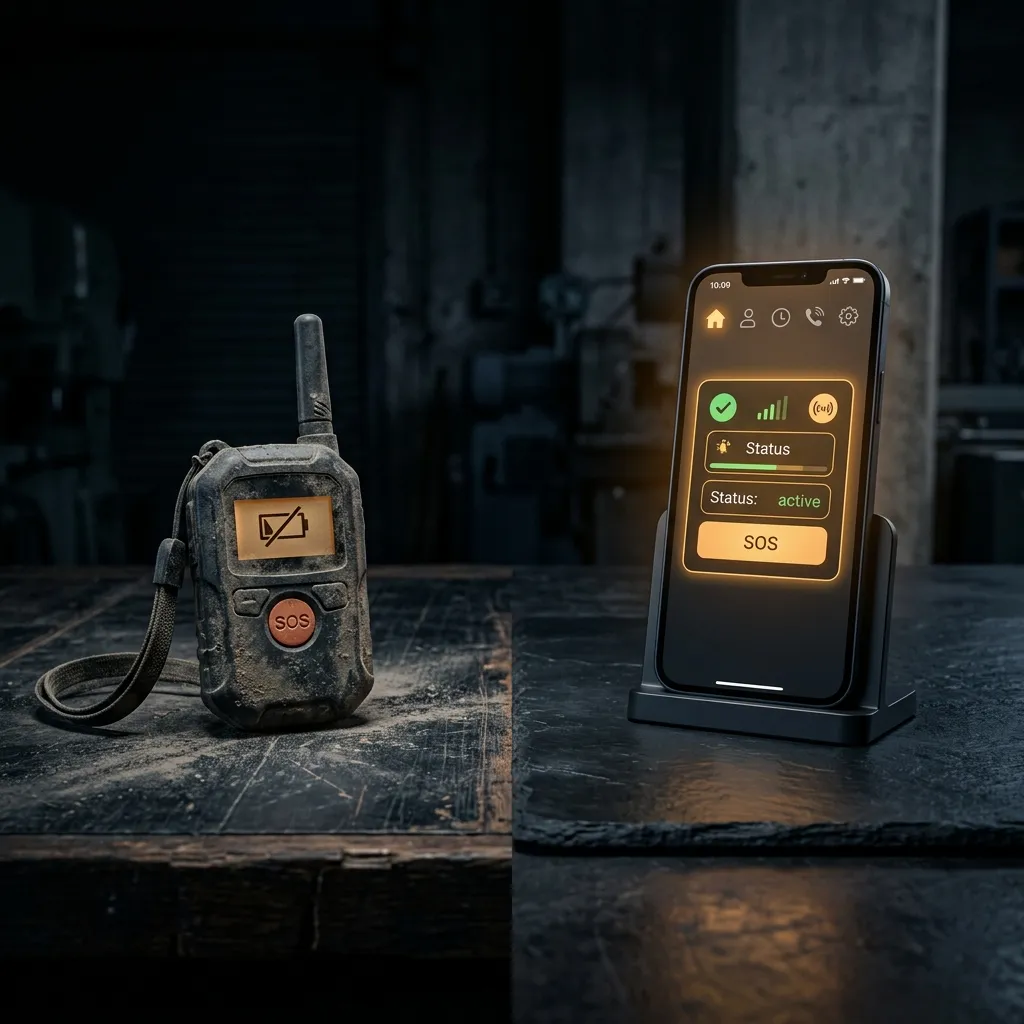
Physical Fobs vs. Smartphone Apps in the Field
The debate over physical lone worker devices versus smartphone apps has been raging across Reddit communities for years. In r/SafetyProfessionals, a thread titled "Lone worker safety devices" generated dozens of comments from safety managers across industries, each defending their preferred approach. The conversation reveals a clear industry divide — and a equally clear winner for the property sector.
The case for physical devices is legitimate in specific contexts. In heavy industry — oil and gas, construction, remote utilities work — environments where smartphones are impractical or hazardous, dedicated devices serve a real purpose. Some industrial settings require intrinsically safe equipment that cannot trigger explosions in volatile atmospheres. Others involve locations with no cellular coverage, where satellite-connected fobs are the only option. In these scenarios, the physical device is not a preference. It is a necessity born of the working environment.
The property sector shares none of these constraints. Estate agents, letting agents, and property managers work in urban and suburban environments with reliable cellular coverage. They carry smartphones as a matter of course — the device is their camera, their navigation tool, their communication channel with clients and colleagues. The working environment is a residential property, a high street office, or a client's home. There is no explosive atmosphere. There is no satellite requirement. The physical fob, in this context, solves a problem that does not exist while introducing several that do.
The Reddit thread on r/SafetyProfessionals about "Man Down alarms that can be monitored by an alarm system" highlighted the practical failure mode of physical devices in non-industrial settings. Multiple commenters described the same pattern: staff issued with fobs leave them in desk drawers, in car gloveboxes, or at home. The device is an additional item to remember, an additional battery to charge, and an additional thing that can be forgotten in the rush between viewings. When the fob is not on the worker's person at the moment of crisis, it provides zero protection — regardless of how sophisticated its technology is.
The smartphone app inverts this dynamic entirely. Staff do not forget their phones. They do not leave them in gloveboxes. The phone is the first thing they check in the morning and the last thing they look at before bed. It is the device they reach for instinctively in an emergency. By placing the safety system on the device that is already in the worker's hand, adoption rates climb from the 40-60% typical of physical fob deployments to near-universal usage. The safety system is not something the worker has to remember to carry. It is something that is already there.
One Reddit commenter, a safety manager for a property management firm, described the transition succinctly: "We spent three years trying to get staff to carry their fobs. We spent three weeks getting them to use the app. The difference is that the app lives on the thing they are already holding."
The Hidden Financial Drain of Hardware
The purchase price of a physical lone worker device is only the beginning of the cost story. Reddit procurement discussions in r/SafetyProfessionals and r/sysadmin reveal a pattern of hidden and compounding costs that make hardware-based systems dramatically more expensive than their sticker price suggests — and the full financial impact often does not become clear until the second or third year of deployment.
Device procurement and shipping. Physical fobs or dedicated devices must be purchased for every employee, shipped to each location, and individually registered to the monitoring platform. For a multi-branch estate agency, this means managing an inventory of devices across offices, tracking which employee has which device, and replacing units that are lost, damaged, or reach end of life. The administrative overhead alone is significant — someone has to manage the device fleet, and that someone's time is not free.
Replacement and repair costs. Physical devices break. They are dropped, stepped on, exposed to rain, and left in hot cars. Battery degradation means devices that held a charge for a full shift in year one need recharging by midafternoon in year three. Each replacement device carries a unit cost, shipping cost, and re-registration cost. For a 10-person agency, assuming one device replacement per quarter across the team — a conservative estimate based on Reddit reports — the annual replacement cost alone can exceed £500.
IT integration and setup. Hardware-based systems frequently require IT department involvement to provision devices, configure network access, and integrate with existing systems. For smaller agencies without a dedicated IT team, this means either outsourcing the setup at consultant rates or pulling a fee-earning staff member off their normal duties to manage the deployment. The Sentry's SMS-based deployment, by contrast, requires zero IT involvement. An administrator uploads a staff list, the platform sends invites, and staff self-provision via their app store.
Multi-year contract lock-ins. The business model of most hardware-based providers depends on amortising device costs over long contract terms. This is why StaySafe, Peoplesafe, and SoloProtect typically require 24 to 36-month commitments. The hardware is subsidised by the contract length — and the penalty for early termination is designed to recover the unsubsidised device cost. For a growing agency, this creates a structural problem: if you add staff in year two, you either pay a premium for additional devices outside the original contract or wait until renewal. If you lose staff, you are paying for devices that sit unused in a drawer.
The cumulative financial picture is stark. A 10-person agency using a hardware-based system at £114-£180 per user per year, with multi-year lock-ins, setup fees, and replacement costs, can easily spend £1,500 to £2,500 per year more than the same agency using The Sentry at £39.50 per user per year. Over a three-year contract period — the typical lock-in term — that is £4,500 to £7,500 in additional spend, with no corresponding improvement in safety outcomes for the property sector. In many cases, the safety outcome is worse, because the fobs are sitting in desk drawers while the app would be on the worker's phone.
Why Software Wins: Zero IT and Instant Compliance
The Sentry represents the architecture that the Reddit consensus is converging toward: a cloud-first, app-only platform that leverages the devices staff already carry, deploys in under an hour, and delivers compliance capabilities that hardware-based systems structurally cannot match. The argument is not that physical devices are inherently bad. It is that for the property sector, the software approach is objectively superior on every axis that matters: cost, deployment speed, adoption, and compliance.
Deployment in under 60 minutes. An administrator creates an account on The Sentry's web portal, enters or uploads the staff list, and the platform sends SMS invite links to each employee. Staff download the app from the iOS App Store or Google Play, tap the invite link, and their account is active. There is no device to ship, no IT ticket to raise, no configuration file to push. A 50-person agency can be fully deployed before the end of a single morning. This is particularly significant for agencies that need to demonstrate compliance quickly — whether in response to a new contract requirement, an insurance audit, or the approaching October 2026 ERA 2025 deadline.
Full compliance at £39.50 per user per year. The Sentry's price point is not a stripped-down version of a more expensive platform. It is the complete feature set: one-touch panic alarm, silent distress signal, live GPS tracking, timed check-in sessions with automatic escalation, fake incoming call widget, automatic smartphone video capture on alarm trigger, private incident reporting channel, whistleblowing-aligned disclosure pathway, compliance documentation pack, and three free Friends and Family personal licences per commercial user. At £39.50 per user per year — less than £1 per week — this represents the most cost-effective compliance solution in the UK lone worker market. For a 10-person agency, the annual cost is £395. For a 50-person agency, it is £1,975. There are no setup fees, no hardware costs, and no multi-year lock-ins.
Compliance capabilities hardware cannot deliver. The most significant advantage of the software approach is not cost or deployment speed — it is compliance. Physical fobs are designed for one purpose: routing an alarm to a monitoring centre. That is a 2010 requirement. The Employment Rights Act 2025 creates a fundamentally different compliance landscape. Employers need a private incident reporting channel aligned to whistleblowing protections. They need automatic video capture that records evidence the moment an alarm is triggered. They need a compliance portal that generates downloadable, timestamped audit trail documentation. They need a compliance documentation pack with policy templates and risk assessments. None of these capabilities exist in a physical fob. They are software features, and The Sentry was engineered with all of them as standard.
The privacy advantage. A physical device that tracks location continuously is a privacy concern that employees react against — a recurring theme in Reddit discussions about employee surveillance. The Sentry's session-based model eliminates this objection entirely. The app shares live GPS location only during user-initiated active working sessions. When the session ends, tracking stops. There is no background monitoring, no off-hours location data, and no surveillance of personal movements. This is the model that staff accept, trust, and actually use — and it is only possible with software that gives the user control over when tracking begins and ends.
The Reddit debate between devices and apps will continue in industrial contexts where physical hardware serves a genuine purpose. But for estate agencies, letting agents, and property management firms, the debate is over. The software approach costs less, deploys faster, achieves higher adoption, and delivers the compliance capabilities that the 2026 legal landscape demands. The question is not whether to switch. It is how quickly you can deploy.
Previously: Moving away from manual check-ins? See lone worker check in app reddit — why automated, timestamped check-in systems are replacing WhatsApp and phone trees.
Next in this series: Ready to evaluate specific competitors? Read staysafe app alternative reddit — a direct cost and feature comparison between The Sentry and the market incumbent.