
Two different jobs, one assumption that they’re the same job
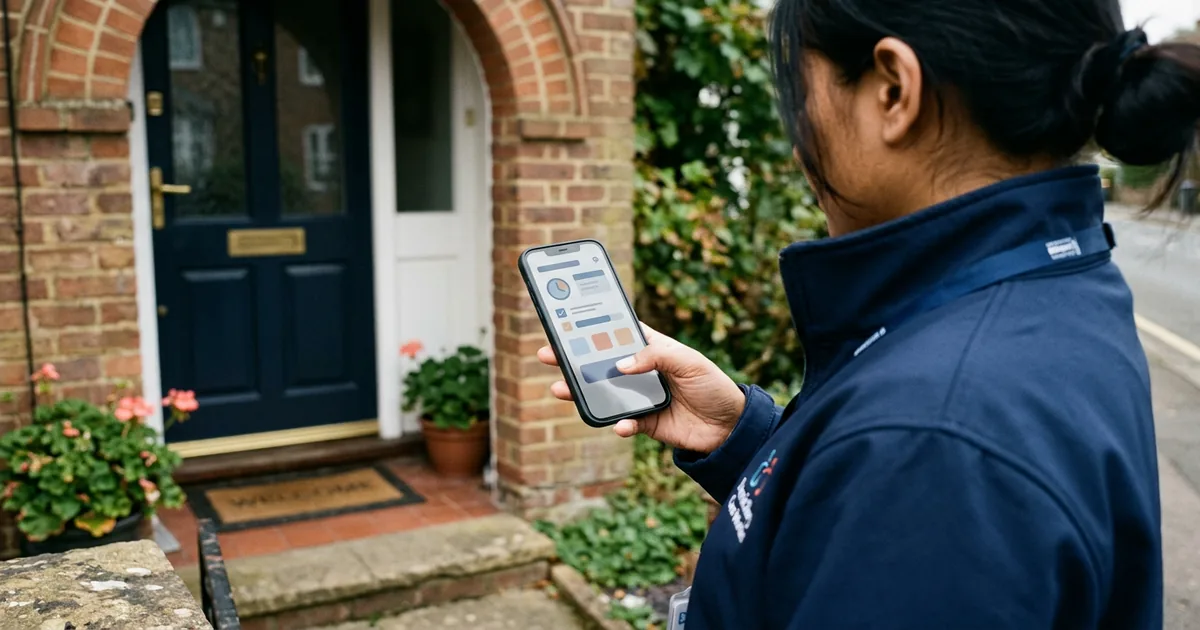
If your local authority contract requires Electronic Call Monitoring, it’s easy to assume you’ve already covered your lone worker safety duty. It’s an understandable assumption to make: both systems live on the same phone, both get triggered on the same visit, and both feed into the same conversation about “the software we use.” But they answer two completely different questions. ECM answers “did the visit happen, when, and for how long.” A domiciliary care lone worker safety app answers “is the person who made that visit safe right now.” One is evidence for a commissioner. The other is protection for a worker. Meeting one doesn’t meet the other.
What Electronic Call Monitoring actually does
Electronic Call Monitoring (ECM) verifies that a scheduled visit took place: usually GPS-based confirmation of arrival and departure time at a client’s address, sometimes backed up by a QR code scan at the property as a secondary check. Local authorities increasingly require it as a contractual condition, because it gives commissioners an auditable way to match hours paid to hours actually delivered, replacing paper timesheets and manual phone check-ins.
Modern ECM and care management systems have grown well beyond simple clock-in and clock-out logging. Many now flag a missed visit, a late arrival, or a medication that wasn’t administered as recorded, and route that flag to the office so a manager can follow it up. That’s genuinely useful for care quality and for the audit trail CQC expects under its Well-Led framework. It is not the same thing as a worker being able to raise an alarm the moment something goes wrong on the doorstep. For more on safety procedures for home-visiting teams, see our practical lone working policy guide.
What it was never built to do
No ECM system on the market is designed, marketed, or accredited as a personal safety escalation tool. It doesn’t give a worker a way to silently signal they’re in danger mid-visit. It doesn’t record video or audio if a situation turns confrontational. It doesn’t automatically notify a nominated contact and escalate if something goes wrong, because it isn’t monitoring for that; it’s monitoring whether the visit itself was completed and logged correctly. A worker who feels unsafe standing on a doorstep gains nothing from a system built to prove they arrived on time.
This isn’t a criticism of ECM. It’s doing exactly the job it was designed for, verifying commissioned care was delivered. The problem is only when a provider assumes that job also covers the separate legal duty to protect the worker’s personal safety while they’re doing it.
The compliance landscape is getting more crowded, not less
It’s worth naming why this confusion is only getting easier to fall into. Domiciliary care providers are now juggling several different digital systems that all touch the same visit, for entirely different reasons. Alongside ECM, England’s Digitising Social Care programme introduced the Minimum Operational Data Standard (MODS) in April 2025, requiring every supplier on the NHS Assured Solutions List to certify their digital social care record systems by 1 July 2026, so that care record data is captured consistently and can move safely between care providers, GPs and the wider NHS. MODS is about the structure and quality of care record data. It has nothing to do with a worker’s personal safety either.
Put ECM, MODS and a lone worker safety app side by side and the pattern is clear: one proves a visit happened, one standardises what gets recorded about the person receiving care, and one protects the person delivering it. Three different systems, three different purposes, all sitting on the same phone. Treating any one of them as covering another creates a genuine gap, and the gap that matters most here is the one around the worker’s own safety, because it’s the one with no commissioner or NHS programme checking whether it’s been filled.
What the actual lone worker duty requires
The legal duty here doesn’t come from a commissioner contract or an NHS data standard. It comes from the Health and Safety at Work Act 1974 and the Management of Health and Safety at Work Regulations 1999, which require employers to assess and control risks to staff working alone. HSE’s own guidance, INDG73, states plainly that a standard mobile phone on its own is not an adequate control measure for lone working risk. An ECM app running on that same phone doesn’t change that assessment, because it isn’t built to respond if something goes wrong; it’s built to confirm the visit took place. See the UK lone worker compliance framework for the broader employer obligations.
How The Sentry helps
The Sentry sits alongside ECM, not instead of it. Providers still need ECM to meet their commissioning contract and evidence delivered care; The Sentry covers the separate lone worker compliance duty ECM was never designed to touch. A one-touch widget on the worker’s home screen raises the alarm without opening an app or navigating a login screen. Every alarm records video throughout, and the silent version also records audio, so there’s a genuine account of what happened rather than a manager’s best guess after the fact. The check-in timer can be configured to escalate automatically to a worker’s nominated contacts if a check-in is missed, and the incident reporting tool lets a worker log a concerning visit properly, with location, time and photos captured together, rather than mentioning it in passing at the next handover.
None of this duplicates what ECM already does well. It fills the part of the picture ECM was never meant to cover, closing the duty of care gap that no commissioning contract or NHS data standard was ever designed to check. Full detail on how this fits domiciliary care is on The Sentry’s domiciliary care industry page. You can also review pricing for the safety layer alongside your existing systems.
If you’re not sure whether your current systems actually cover your lone worker duty, book a free demo to see how a dedicated safety layer sits alongside your existing ECM setup.
Key facts to note
- ECM verifies visit time and location for commissioning and billing purposes; it is not a personal safety alerting system.
- HSE guidance (INDG73) states a mobile phone alone is not an adequate lone worker control measure.
- MODS (Minimum Operational Data Standard, DAPB4102), introduced April 2025 by the Digitising Social Care programme, required all NHS Assured Solutions List suppliers to certify by 1 July 2026. It governs care record data structure, not worker safety.
FAQ
Does having Electronic Call Monitoring mean we’ve met our lone worker safety duty? No. ECM verifies that a visit happened and how long it took, for commissioning and audit purposes. The lone worker duty under the Health and Safety at Work Act 1974 is a separate legal requirement to protect the worker’s personal safety, which ECM isn’t designed to do.
Can ECM alert us if a worker is in danger during a visit? No. Most modern ECM systems can flag operational issues like a missed visit or late arrival, but none are built to let a worker silently raise a personal safety alarm or automatically escalate if they’re at risk.
What’s the difference between MODS and ECM? MODS is an NHS-led data standard governing how digital social care records are structured, so information can move safely between care providers and the NHS. ECM is a visit-verification tool for commissioning and billing. Neither addresses a worker’s personal safety.
Do we need a lone worker safety app if we already use ECM and a MODS-compliant care record system? Yes, if your workers ever visit clients alone. ECM and MODS-compliant care records are about proving a visit happened and standardising what’s recorded about the person receiving care. Personal safety for the worker making the visit is a distinct duty that needs its own tool.
Will a lone worker safety app replace our ECM system? No, and it shouldn’t try to. Your commissioning contract will still require ECM. A lone worker safety app sits alongside it, covering the personal safety duty ECM was never designed to meet.
This article was written by Stuart Evans, co-founder of The Sentry.